


Page 138 - (DK) Smithsinian - Military History: The Definitive Visual Guide to the Objects of Warfare
P. 138
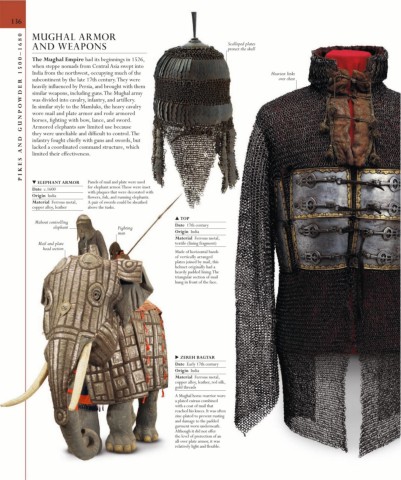
136    MUGHAL ARMOR                                                          Scalloped plates

         WDER 1500–1680  AND WEAPONS                                              protect the skull  Heaviest links


            The Mughal Empire had its beginnings in 1526,
            when steppe nomads from Central Asia swept into
            India from the northwest, occupying much of the
            subcontinent by the late 17th century. They were
                                                                                                    over chest
            heavily influenced by Persia, and brought with them
            similar weapons, including guns. The Mughal army

            In similar style to the Mamluks, the heavy cavalry
         AND GUNPO  was divided into cavalry, infantry, and artillery.
            wore mail and plate armor and rode armored
            horses, fighting with bow, lance, and sword.
            Armored elephants saw limited use because
            they were unreliable and difficult to control. The
            infantry fought chiefly with guns and swords, but
            lacked a coordinated command structure, which
         PIKES   limited their effectiveness.


            ▼ ELEPHANT ARMOR    Panels of mail and plate were used
                                for elephant armor. These were inset
            Date  c.1600
                                with plaques that were decorated with
            Origin  India       flowers, fish, and running elephants.
            Material  Ferrous metal,   A pair of swords could be sheathed
            copper alloy, leather  above the tusks.
                                                               ▲ TOP
             Mahout controlling
                    elephant               Fighting            Date  17th century
                                           man                 Origin  India
                                                               Material  Ferrous metal,
              Mail and plate                                   textile (lining fragment)
                head section
                                                               Made of horizontal bands
                                                               of vertically arranged
                                                               plates joined by mail, this
                                                               helmet originally had a
                                                               heavily padded lining. The
                                                               triangular section of mail
                                                               hung in front of the face.


                                                               ▶ ZEREH BAGTAR
                                                               Date  Early 17th century
                                                               Origin  India
                                                               Material  Ferrous metal,
                                                               copper alloy, leather, red silk,
                                                               gold threads
                                                               A Mughal horse-warrior wore
                                                               a plated cuirass combined
                                                               with a coat of mail that
                                                               reached his knees. It was often
                                                               zinc-plated to prevent rusting
                                                               and damage to the padded
                                                               garment worn underneath.
                                                               Although it did not offer
                                                               the level of protection of an
                                                               all-over plate armor, it was
                                                               relatively light and flexible.

