


Page 254 - (DK) Smithsinian - Military History: The Definitive Visual Guide to the Objects of Warfare
P. 254
252

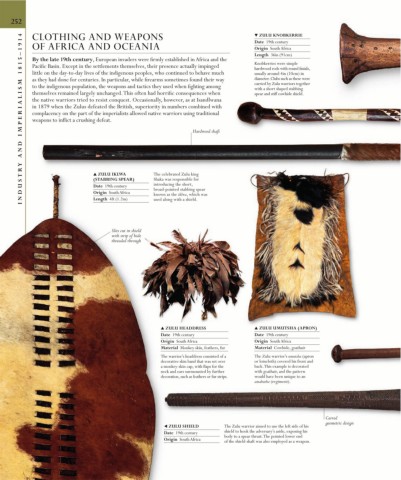
            CLOTHING AND WEAPONS                                                            ▼ ZULU KNOBKERRIE
         AND IMPERIALISM 1815–1914
            OF AFRICA AND OCEANIA                                                           Date  19th century
                                                                                            Origin  South Africa
                                                                                            Length  36in (91cm)
            By the late 19th century, European invaders were firmly established in Africa and the
            Pacific Basin. Except in the settlements themselves, their presence actually impinged   Knobkerries were simple
                                                                                            hardwood rods with round finials,
            little on the day-to-day lives of the indigenous peoples, who continued to behave much    usually around 4in (10cm) in
            as they had done for centuries. In particular, while firearms sometimes found their way   diameter. Clubs such as these were
            to the indigenous population, the weapons and tactics they used when fighting among   carried by Zulu warriors together
                                                                                            with a short shaped stabbing
            themselves remained largely unchanged. This often had horrific consequences when    spear and stiff cowhide shield.
            the native warriors tried to resist conquest. Occasionally, however, as at Isandlwana
            in 1879 when the Zulus defeated the British, superiority in numbers combined with
            complacency on the part of the imperialists allowed native warriors using traditional
            weapons to inflict a crushing defeat.

                                                                      Hardwood shaft


         Y                        ▲ ZULU IKLWA          The celebrated Zulu king
         INDUSTR                  (STABBING SPEAR)      Shaka was responsible for

                                                        introducing the short,
                                  Date  19th century
                                                        broad-pointed stabbing spear
                                  Origin  South Africa
                                                        known as the iklwa, which was
                                  Length  4ft (1.2m)
                                                        used along with a shield.


                                         Slits cut in shield
                                         with strip of hide
                                         threaded through


                                                          ▲ ZULU HEADDRESS                  ▲ ZULU UMUTSHA (APRON)
                                                          Date  19th century                Date  19th century
                                                          Origin  South Africa              Origin  South Africa
                                                          Material  Monkey skin, feathers, fur  Material  Cowhide, goathair
                                                          The warrior’s headdress consisted of a   The Zulu warrior’s umutsha (apron
                                                          decorative skin band that was set over    or loincloth) covered his front and
                                                          a monkey-skin cap, with flaps for the   back. This example is decorated
                                                          neck and ears surmounted by further   with goathair, and the pattern
                                                          decoration, such as feathers or fur strips.  would have been unique to an
                                                                                            amabutho (regiment).


                                                                                                                     Carved
                                                                                                                     geometric design
                                                           ◀ ZULU SHIELD         The Zulu warrior aimed to use the left side of his
                                                           Date  19th century    shield to hook the adversary’s aside, exposing his
                                                                                 body to a spear thrust. The pointed lower end
                                                           Origin  South Africa  of the shield-shaft was also employed as a weapon.

