


Page 256 - (DK) Smithsinian - Military History: The Definitive Visual Guide to the Objects of Warfare
P. 256
254

            SELF-LOADING PISTOLS
         AND IMPERIALISM 1815–1914
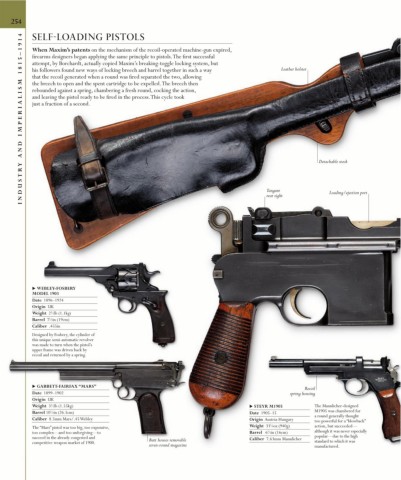
            When Maxim’s patents on the mechanism of the recoil-operated machine-gun expired,
            firearms designers began applying the same principle to pistols. The first successful
            attempt, by Borchardt, actually copied Maxim’s breaking-toggle locking system, but
            his followers found new ways of locking breech and barrel together in such a way         Leather holster
            that the recoil generated when a round was fired separated the two, allowing
            the breech to open and the spent cartridge to be expelled. The breech then
            rebounded against a spring, chambering a fresh round, cocking the action,
            and leaving the pistol ready to be fired in the process. This cycle took
            just a fraction of a second.


         Y                                                                                                         Detachable stock
         INDUSTR                                                                                Tangent               Loading/ejection port


                                                                                                rear sight


            ▶ WEBLEY-FOSBERY
            MODEL 1903
            Date  1896–1924
            Origin  UK
                   1
            Weight  2 ⁄2lb (1.1kg)
                  1
            Barrel  7 ⁄2in (19cm)
            Caliber  .455in
            Designed by Fosbery, the cylinder of
            this unique semi-automatic revolver
            was made to turn when the pistol’s
            upper frame was driven back by
            recoil and returned by a spring.


            ▶ GABBETT-FAIRFAX “MARS”
                                                                                                              Recoil
            Date  1899–1902                                                                             spring housing
            Origin  UK
                   1
            Weight  3 ⁄2lb (1.55kg)                                                       ▶ STEYR M1905          The Mannlicher-designed
                   1
            Barrel 10 ⁄2in (26.5cm)                                                       Date  1905–15          M1905 was chambered for
            Caliber  8.5mm Mars/.45 Webley                                                Origin  Austria-Hungary  a round generally thought
                                                                                                                 too powerful for a “blowback”
                                                                                                 1
            The “Mars” pistol was too big, too expensive,                                 Weight  33 ⁄4oz (940g)  action, but succeeded—
                                                                                                1
            too complex—and too unforgiving—to                                            Barrel   6 ⁄2in (16cm)  although it was never especially
            succeed in the already congested and      Butt houses removable               Caliber  7.63mm Mannlicher  popular—due to the high
            competitive weapon market of 1900.                                                                   standard to which it was
                                                      seven-round magazine                                       manufactured.

