


Page 306 - (DK) Smithsinian - Military History: The Definitive Visual Guide to the Objects of Warfare
P. 306
304 BOMBER AIRCRAFT
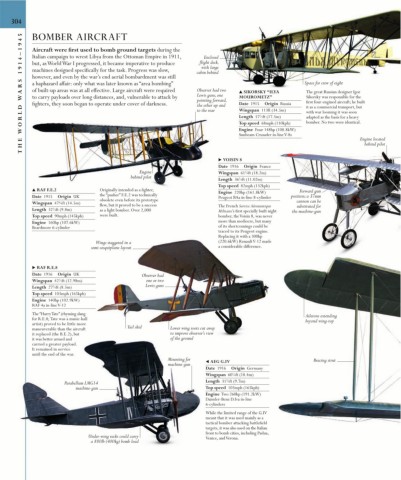
1914–1945 Aircraft were first used to bomb ground targets during the flight deck,
Italian campaign to wrest Libya from the Ottoman Empire in 1911,
Enclosed
but, as World War I progressed, it became imperative to produce
with large
however, and even by the war’s end aerial bombardment was still
ARS machines designed specifically for the task. Progress was slow, cabin behind ▲ SIKORSKY “ILYA Space for crew of eight
a haphazard affair: only what was later known as “area bombing”
of built-up areas was at all effective. Large aircraft were required
Observer had two
The great Russian designer Igor
Lewis guns, one
to carry payloads over long distances, and, vulnerable to attack by
MOUROMETZ”
Sikorsky was responsible for the
ORLD W fighters, they soon began to operate under cover of darkness. pointing forward, Date 1915 Origin Russia first four-engined aircraft; he built
the other up and
it as a commercial transport, but
Wingspan 113ft (34.5m)
to the rear
with war looming it was soon
Length 57 ⁄2ft (17.5m)
1
adapted as the basis for a heavy
bomber. No two were identical.
Top speed 68mph (110kph)
THE W Engine Four 148hp (108.8kW) Engine located
Sunbeam Crusader in-line V-8s
behind pilot
▶ VOISIN 8
Date 1916 Origin France
Engine Wingspan 61 ⁄4ft (18.2m)
3
behind pilot 1
Length 36 ⁄4ft (11.02m)
Top speed 82mph (132kph)
▲ RAF F.E.2 Originally intended as a fighter, Engine 220hp (161.8kW) Forward gun
Date 1915 Origin UK the “pusher” F.E.2 was technically Peugeot BAa in-line 8-cylinder position; a 37mm
obsolete even before its prototype
Wingspan 47¾ft (14.5m) flew, but it proved to be a success The French Service Aéronautique cannon can be
substituted for
Length 32 ⁄4ft (9.8m) as a light bomber. Over 2,000 Militaire’s first specially built night the machine-gun
1
Top speed 90mph (145kph) were built. bomber, the Voisin 8, was never
Engine 160hp (107.6kW) more than mediocre, but many
Beardmore 6-cylinder of its shortcomings could be
traced to its Peugeot engine.
Replacing it with a 300hp
Wings staggered in a (220.6kW) Renault V-12 made
semi-sesquiplane layout a considerable difference.
▶ RAF R.E.8
Date 1916 Origin UK Observer had
1
Wingspan 42 ⁄2ft (12.98m) one or two
3
Length 27 ⁄4ft (8.5m) Lewis guns
Top speed 103mph (165kph)
Engine 140hp (102.9kW)
RAF 4a in-line V-12
The “Harry Tate” (rhyming slang Ailerons extending
for R.E.8; Tate was a music-hall beyond wing-top
artist) proved to be little more
maneuverable than the aircraft Tail skid Lower wing roots cut away
it replaced (the B.E.2), but to improve observer’s view
it was better armed and of the ground
carried a greater payload.
It remained in service
until the end of the war.
Mounting for ◀ AEG G.IV Bracing strut
machine-gun
Date 1916 Origin Germany
1
Wingspan 60 ⁄4ft (18.4m)
Length 31 ⁄4ft (9.7m)
3
Parabellum LMG14
machine-gun Top speed 103mph (165kph)
Engine Two 260hp (191.2kW)
Daimler-Benz D.Iva in-line
6-cylinders
While the limited range of the G.IV
meant that it was used mainly as a
tactical bomber attacking battlefield
targets, it was also used on the Italian
front to bomb cities, including Padua,
Under-wing racks could carry Venice, and Verona.
a 880lb (400kg) bomb load

