


Page 210 - (DK) The Business Book
P. 210
208


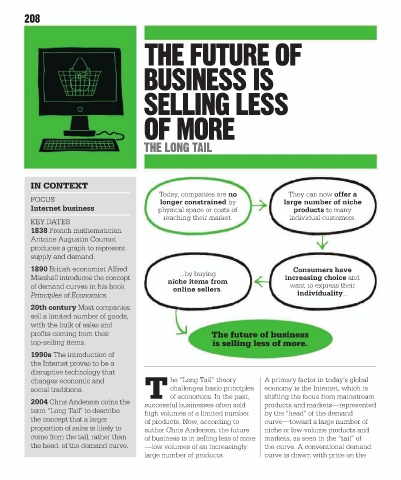
                                                 THE FUTURE OF


                                              BUSINESS IS


                                              SELLING LESS


                                               OF MORE


                                         THE LONG TAIL


          IN CONTEXT
                                             Today, companies are no             They can now offer a
          FOCUS                              longer constrained by             large number of niche
          Internet business                  physical space or costs of           products to many
                                              reaching their market.             individual customers.
          KEY DATES
          1838 French mathematician
          Antoine Augustin Cournot
          produces a graph to represent
          supply and demand.
          1890 British economist Alfred                                           Consumers have
                                                  ...by buying
          Marshall introduces the concept                                       increasing choice and
                                               niche items from
          of demand curves in his book                                           want to express their
                                                 online sellers.
          Principles of Economics.                                                 individuality...
          20th century Most companies
          sell a limited number of goods,
          with the bulk of sales and
          profits coming from their                         The future of business
          top-selling items.                                is selling less of more.
          1990s The introduction of
          the Internet proves to be a
          disruptive technology that
          changes economic and                  he “Long Tail” theory     A primary factor in today’s global
          social traditions.                    challenges basic principles   economy is the Internet, which is
                                         T of economics. In the past,     shifting the focus from mainstream
          2004 Chris Anderson coins the
                                         successful businesses often sold   products and markets—represented
          term “Long Tail” to describe
                                         high volumes of a limited number   by the “head” of the demand
          the concept that a larger      of products. Now, according to   curve—toward a large number of
          proportion of sales is likely to   author Chris Anderson, the future   niche or low-volume products and
          come from the tail, rather than   of business is in selling less of more  markets, as seen in the “tail” of
          the head, of the demand curve.  —low volumes of an increasingly   the curve. A conventional demand
                                         large number of products.        curve is drawn with price on the

