


Page 29 - (DK Eyewitness) Travel Guide - Estonia Latvia & Lithuania
P. 29
A  POR TRAIT  OF  EST ONIA ,  LA T VIA  AND  LITHU ANIA       27


       Music
       Estonia has a strong tradition of classical
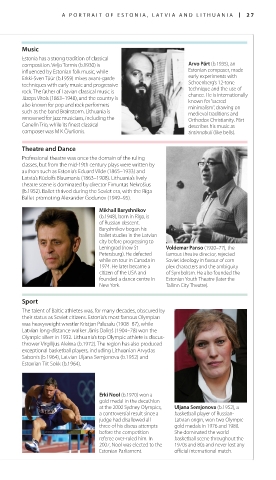
       composition. Veljo Tormis (b.1930) is     Arvo Pärt (b.1935), an
       influenced by Estonian folk music, while   Estonian composer, made
       Erkki-Sven Tüür (b.1959) mixes avant-garde   early experiments with
       techniques with early music and progressive   Schoenberg’s 12-tone
       rock. The father of Latvian classical music is   technique and the use of
                                                 chance. He is internation ally
       Jāzeps Vītols (1863–1948), and the country is   known for “sacred
       also known for pop and rock performers    minimalism”, drawing on
       such as the band Brainstorm. Lithuania is   medieval traditions and
       renowned for jazz musicians, inclu ding the   Orthodox Christianity. Pärt
       Ganelin Trio, while its finest classical   describes his music as
       composer was M K Čiurlionis.              tintinnabuli (like bells).
       Theatre and Dance
       Professional theatre was once the domain of the ruling
       classes, but from the mid-19th century plays were written by
       authors such as Estonia’s Eduard Vilde (1865–1933) and
       Latvia’s Rūdolfs Blaumanis (1863–1908). Lithuania’s lively
       theatre scene is dominated by director Eimuntas Nekrošius
       (b.1952). Ballet thrived during the Soviet era, with the Rīga
       Ballet promoting Alexander Godunov (1949–95).
                           Mikhail Baryshnikov
                           (b.1948), born in Rīga, is
                           of Russian descent.
                           Baryshnikov began his
                           ballet studies in the Latvian
                           city before pro gressing to
                           Leningrad (now St   Voldemar Panso (1920–77), the
                           Petersburg). He defected   famous theatre director, rejected
                           while on tour in Canada in   Soviet ideology in favour of com-
                           1974. He later became a   plex characters and the ambiguity
                           citizen of the USA and   of Symbolism. He also founded the
                           founded a dance centre in   Estonian Youth Theatre (later the
                           New York.        Tallinn City Theatre).

       Sport
       The talent of Baltic athletes was, for many decades, obscured by
       their status as Soviet citizens. Estonia’s most famous Olympian
       was heavyweight wrestler Kristjan Palusalu (1908–87), while
       Latvian long-distance walker Jānis Daliņš (1904–78) won the
       Olympic silver in 1932. Lithuania’s top Olympic athlete is discus-
       thrower Virgilijus Alekna (b.1972). The region has also produced
       exceptional basketball players, including Lithuanian Arvydas
       Sabonis (b.1964), Latvian Uljana Semjonova (b.1952) and
       Estonian Tiit Sokk (b.1964).


                           Erki Nool (b.1970) won a
                           gold medal in the decathlon
                           at the 2000 Sydney Olympics,   Uljana Semjonova (b.1952), a
                           a controversial result since a   basketball player of Russian-
                           judge had disallowed all   Latvian origin, won two Olympic
                           three of his discus attempts   gold medals in 1976 and 1980.
                           before the competition   She dominated the world
                           referee over-ruled him. In   basketball scene throughout the
                           2007, Nool was elected to the   1970s and 80s and never lost any
                           Estonian Parliament.  official international match.

