


Page 38 - (DK Eyewitness) Travel Guide - Estonia Latvia & Lithuania
P. 38
36       INTRODUCING  EST ONIA ,  LA T VIA  AND  LITHU ANIA


       Germans in Estonia and Latvia  Saaremaa, was subjugated in 1227.
       After the papal declaration of the crusade,   A fortress built in 1260 at its capital,
       the Teutonic Knights, or the German warrior-  Kuressaare, is the only one in the Baltic
       monks who had previously called themselves  region to be preserved largely as the
       the Brotherhood of the Sword, began to   Teutonic Knights built it. Livonia flourished
       venture along the Baltic Coast. The phrase   under the Knights, as they built cities
       “Drang nach Osten” (“Thrust Eastwards”),   throughout the region. After joining the
       which would become notorious in World   Hanseatic League, a trading confederation
       War II, dates from this time. Religious and   of German port-cities and merchants’
       commercial zeal drove the crusa ders to   associations, Tallinn and Rīga began to
       establish colonies along the Baltic Coast. In   thrive. The new social order, dominated by
       1201, a bishopric was set up in Rīga, which   the Germans, excluded the local inhabi-
       became the basis for the Baltic conquest.   tants not only from mercantile acti vities,
       Expanding into Estonia from the south, the   but also agriculture, where they could only
       Knights created Livonia in 1207. Comprising  be hired as serfs.
       Latvia and Estonia, Livonia was recognized
       as part of the Holy Roman Empire, with   Polish Domination in Lithuania
       Rīga as the capital. Estonia’s largest island,   Lithuania has a very different history from
                                     that of the area to its north. While
                                     Christianity was dominant in much of the
                                     Baltic region, Lithuania continued to be
                                     reso lutely pagan until 1385, when
                                     Duke Jogaila married a Polish prin cess,
                                     embraced Christianity and assumed the
                                     crowns of Poland and Lithuania. Long
                                     before him, in 1251, Mindaugas had briefly
                                     adopted Christianity so that he could be
                                     crowned by the Pope. In 1410, Jogaila and
                                     his cousin Vytautas (r.1410–30), Grand
                                     Prince of Lithuania, decisively defeated the
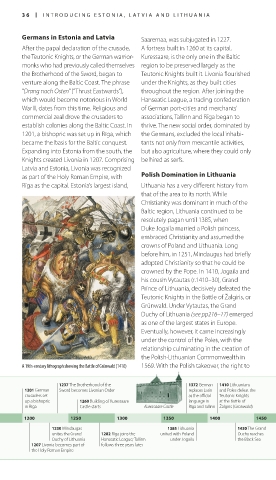
                                     Teutonic Knights in the Battle of Žalgiris, or
                                     Grünwald. Under Vytautas, the Grand
                                     Duchy of Lithuania (see pp216–17) emerged
                                     as one of the largest states in Europe.
                                     Eventually, however, it came increasingly
                                     under the control of the Poles, with the
                                     rela tionship culminating in the creation of
                                     the Polish-Lithuanian Commonwealth in
       A 19th-century lithograph showing the Battle of Grünwald (1410)  1569. With the Polish takeover, the right to

                1237 The Brotherhood of the      1372 German   1410 Lithuanians
       1201 German   Sword becomes Livonian Order  replaces Latin   and Poles defeat the
       crusaders set                             as the official   Teutonic Knights
       up a bishopric   1260 Building of Kuressaare   language in   at the Battle of
       in Rīga       Castle starts    Kuressaare Castle  Rīga and Tallinn  Žalgiris (Grünwald)
       1200        1250        1300        1350        1400        1450
              1230 Mindaugas                1385 Lithuania    1430 The Grand
              unites the Grand   1282 Rīga joins the   united with Poland   Duchy reaches
              Duchy of Lithuania  Hanseatic League; Tallinn   under Jogaila  the Black Sea
         1207 Livonia becomes part of   follows three years later
         the Holy Roman Empire

