


Page 33 - (DK Eyewitness) Travel Guide - Estonia Latvia & Lithuania
P. 33
A  POR TRAIT  OF  EST ONIA ,  LA T VIA  AND  LITHU ANIA       31


       Uses of Amber                          The Amber Road
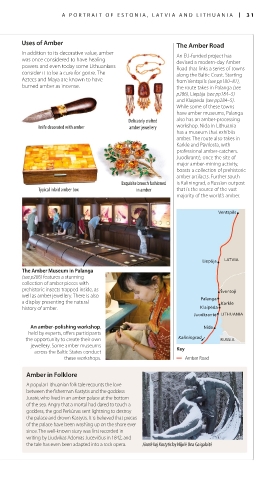
       In addition to its decorative value, amber   An EU-funded project has
       was once considered to have healing    devised a modern-day Amber
       powers and even today some Lithuanians   Road that links a series of towns
       consider it to be a cure for goitre. The   along the Baltic Coast. Starting
       Aztecs and Maya are known to have      from Ventspils (see pp180–81),
       burned amber as incense.               the route takes in Palanga (see
                                              p286), Liepāja (see pp184–5)
                                              and Klaipėda (see pp284–5).
                                              While some of these towns
                                              have amber museums, Palanga
                                  Delicately crafted   also has an amber-processing
           Knife decorated with amber  amber jewellery  workshop. Nida in Lithuania
                                              has a museum that exhibits
                                              amber. The route also takes in
                                              Karklė and Pāvilosta, with
                                              professional amber-catchers.
                                              Juodkrantė, once the site of
                                              major amber-mining activity,
                                              boasts a collection of pre historic
                                              amber artifacts. Further south
                                Exquisite brooch fashioned   is Kaliningrad, a Russian outpost
           Typical inlaid amber box  in amber  that is the source of the vast
                                              majority of the world’s amber.

                                                         Ventspils  •


                                                     Liepāja  •  LATVIA
       The Amber Museum in Palanga
       (see p286) features a stunning
       collection of amber pieces with
       prehistoric insects trapped inside, as            •Šventoji
       well as amber jewellery. There is also
       a display presenting the natural              Palanga  • • Karklė
       history of amber.                            Klaipėda  •
                                                   Juodkrantė  • LITHUANIA
         An amber-polishing workshop,                Nida  •
        held by experts, offers participants
        the opportunity to create their own    Kaliningrad  RUSSIA
         jewellery. Some amber museums
          across the Baltic States conduct    Key
                  these workshops.               Amber Road

        Amber in Folklore
        A popular Lithuanian folk tale recounts the love
        between the fisherman Kastytis and the goddess
        Juratė, who lived in an amber palace at the bottom
        of the sea. Angry that a mortal had dared to touch a
        goddess, the god Perkūnas sent lightning to destroy
        the palace and drown Kastytis. It is believed that pieces
        of the palace have been washing up on the shore ever
        since. The well-known story was first recorded in
        writing by Liudvikas Adomas Jucevičius in 1842, and
        the tale has even been adapted into a rock opera.  Jūratė kaj Kastytis by Nijolė Ona Gaigalaitė

