


Page 37 - (DK Eyewitness) Travel Guide - Estonia Latvia & Lithuania
P. 37
THE  HIST OR Y  OF  EST ONIA ,  LA T VIA  AND  LITHU ANIA       35

       THE HISTORY OF

       ESTONIA, LATVIA

       AND LITHUANIA


       The history of the Baltic region begins in 3000 BC with the arrival of the early Baltic
       tribes, the ancestors of today’s Estonians, Latvians and Lithuanians. Despite
       a shared experience of conquest, foreign occupation and struggles for
       independence, the three countries have preserved their distinct cultural
       identities, emerging in 1991 as sovereign states.

       Archaeological evidence sug gests that the   coast, the Prussians beyond the Nemunas
       Baltic region was inhabited as early as    river, the Zemgalians in central Latvia and
       10,000 BC, at the end of the Ice Age. The   the Selonians and Latgalians further east.
       earliest occu pied site, at Kernavė in   For several centuries, the Balts remained
       Lithuania, dates back to 9000 BC. These   firmly rural, living off the land. Until the early
       Stone Age people used bows, arrows and   1200s, there were simi lar but un related
       spears for hunting and fishing. It was not   settlements all along the coast, from what is
       until 3000 BC, however, that the ancestors   now Klaipėda as far as St Petersburg. There
       of the current inhabitants began to arrive.   are very few records of life at that time as
       Sur viving by hunting and fishing, the   the local communities used wood rather
       Finno-Ugrians – the future Finns and   than stone for all their fortifications and
       Estonians – were among the first to drift   housing. Archaeological research has shown
       across Europe from Asia. They were pushed   that there were extensive trading networks
       back by the Indo-European groups that   across the sea from this area to Sweden and
       arrived in 2000 BC. The Indo-Europeans,   Germany and inland towards Russia. The
       who intro duced crop cultivation and   little written material from that time talks
       animal rearing to the traditional modes    about the Balts as good boat-builders and
       of subsistence, mingled with the existing   dreaded pirates.
       groups, eventually forming the races      At a time when the rest of Europe had
       now known collectively as the Balts.  embraced Christianity, the Balts staunchly
         During the first centuries AD, distinctive   practised paganism. After haphazard
       regional tribes began to form. These    attempts by small groups of Western
       were the Samogitians (Low landers) and   European missionaries to convert the area
       Aukštaitijans (High landers) in western and   to Christianity failed, the first Baltic crusade
       eas tern Lithuania, the Curonians along the   was sanc tioned by Pope Innocent III in 1198.

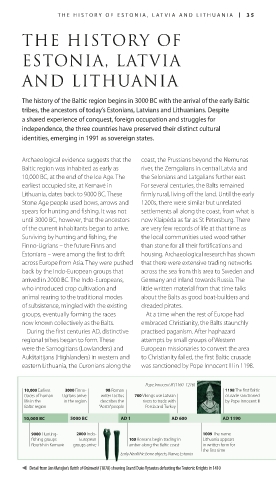
                                      Pope Innocent III (1160–1216)
       10,000 Earliest   3000 Finno-  98 Roman             1198 The first Baltic
       traces of human   Ugrians arrive   writer Tacitus   700 Vikings use Latvian   crusade sanctioned
       life in the    in the region  describes the   rivers to trade with   by Pope Innocent III
       Baltic region      “Aestii” people  Persia and Turkey
       10,000 BC   5000 BC      AD 1         AD 600       AD 1190
         9000 Hunting-  2000 Indo-                   1009 The name
         fishing groups   European   100 Romans begin trading in   Lithuania appears
         flourish in Kernavė  groups arrive  amber along the Baltic coast  in written form for
                                                     the first time
                                Early Neolithic bone objects, Narva, Estonia
         Detail from Jan Matejko’s Battle of Grünwald (1878) showing Grand Duke Vytautas defeating the Teutonic Knights in 1410

