


Page 145 - Vogue - India (January 2020)
P. 145
turned from fur far earlier than luxury brands.
                 “They’re more in touch with the youth,” she
                 says, “and what the next generation of consum-
                 ers actually wants. It’s a given for my children,”
                 she notes, “that you have to show some kind of
                 mindfulness or awareness.”
                    She may have her work cut out for her. A
                 week after our coffee klatch and four days be-
                 fore presenting her spring/summer 2020 show
                 in Paris (“our most sustainable collection
                 ever”), Arnault, addressing an LVMH sustain-
                 ability event in Paris, called out 16-year-old ac-
                 tivist Greta Thunberg for “indulging in an abso-
                 lute catastrophism about the evolution of the
                 world” in her electrifying appearance at the
                 United Nations summit on climate change. “I
                 find it demoralising,” he added. It was perhaps
                 no accident that McCartney raced to put togeth-
                 er a sustainability panel (no questions, no pho-
                 tographs) of her own on the eve of her show at
                 the Opéra Garnier—a panel that included Ex-
                 tinction Rebellion activist Clare Farrell, the leg-
                 endary environmentalist and activist Yann Ar-
                 thus-Bertrand, and author Dana Thomas
                 (Fashionopolis: The Price Of Fast Fashion And
                 The Future Of Clothes), who noted that “we
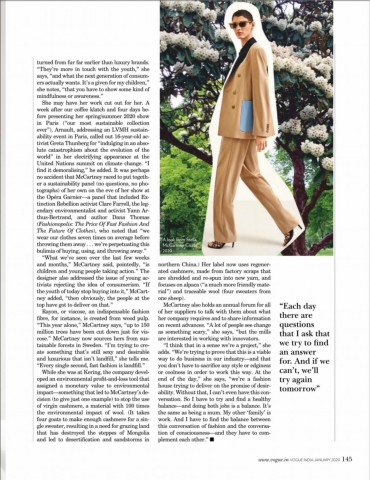
                 wear our clothes seven times on average before          A look from Stella
                 throwing them away . . . we’re perpetuating this        McCartney Cruise
                 bulimia of buying, using, and throwing away.”           2020
                    “What we’ve seen over the last few weeks
                 and months,” McCartney said, pointedly, “is           northern China.) Her label now uses regener-
                 children and young people taking action.” The         ated cashmere, made from factory scraps that
                 designer also addressed the issue of young ac-        are shredded and re-spun into new yarn, and
                 tivists rejecting the idea of consumerism. “If        focuses on alpaca (“a much more friendly mate-
                 the youth of today stop buying into it,” McCart-      rial”) and traceable wool (four sweaters from
                 ney added, “then obviously, the people at the         one sheep).
                 top have got to deliver on that.”                        McCartney also holds an annual forum for all        “Each day
                    Rayon, or viscose, an indispensable fashion        of her suppliers to talk with them about what          there are
                 fibre, for instance, is created from wood pulp.       her company requires and to share information
                 “This year alone,” McCartney says, “up to 150         on recent advances. “A lot of people see change        questions
                 million trees have been cut down just for vis-        as something scary,” she says, “but the mills          that I ask that
                 cose.” McCartney now sources hers from sus-           are interested in working with innovators.
                 tainable forests in Sweden. “I’m trying to cre-          “I think that in a sense we’re a project,” she      we try to find
                 ate something that’s still sexy and desirable         adds. “We’re trying to prove that this is a viable     an answer
                 and luxurious that isn’t landfill,” she tells me.     way to do business in our industry—and that            for. And if we
                 “Every single second, fast fashion is landfill.”      you don’t have to sacrifice any style or edginess
                    While she was at Kering, the company devel-        or coolness in order to work this way. At the          can’t, we’ll
                 oped an environmental profit-and-loss tool that       end of the day,” she says, “we’re a fashion            try again
                 assigned a monetary value to environmental            house trying to deliver on the promise of desir-       tomorrow”
                 impact—something that led to McCartney’s de-          ability. Without that, I can’t even have this con-
                 cision (to give just one example) to stop the use     versation. So I have to try and find a healthy
                 of virgin cashmere, a material with 100 times         balance—and doing both jobs is a balance. It’s
                 the environmental impact of wool. (It takes           the same as being a mum. My other ‘family’ is
                 four goats to make enough cashmere for a sin-         work. And I have to find the balance between
                 gle sweater, resulting in a need for grazing land     this conversation of fashion and the conversa-
                 that has destroyed the steppes of Mongolia            tion of consciousness—and they have to com-
                 and led to desertification and sandstorms in          plement each other.” n


                                                                                                                    www.vogue.in VOGUE INDIA JANUARY 2020 145

