


Page 95 - Nilam_Publication_module_Chemistry_Form.pdf
P. 95
Chemistry Form 4 • MODULE

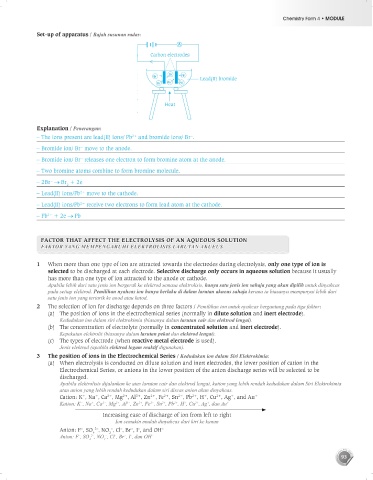
                Set-up of apparatus / Rajah susunan radas:


                                                       Carbon electrodes


                                                                       Lead(II) bromide


                                                           Heat


                Explanation / Penerangan:
                                                2+
                                                                    –
                –  The ions present are lead(II) ions/ Pb  and bromide ions/ Br .
                –  Bromide ion/ Br  move to the anode.
                               –
                               –
                –  Bromide ion/ Br  releases one electron to form bromine atom at the anode.
                –  Two bromine atoms combine to form bromine molecule.
                –  2Br    Br  + 2e
                     –
                          2
                –  Lead(II) ions/Pb  move to the cathode.
                               2+
                –  Lead(II) ions/Pb  receive two electrons to form lead atom at the cathode.
                               2+
                –  Pb  + 2e   Pb
                    2+


                 FACTOR THAT AFFECT THE ELECTROLYSIS OF AN AQUEOUS SOLUTION
                 FAKTOR YANG MEMPENGARUHI ELEKTROLISIS LARUTAN AKUEUS


                1   When more than one type of ion are attracted towards the electrodes during electrolysis, only one type of ion is
                    selected to be discharged at each electrode. Selective discharge only occurs in aqueous solution because it usually
                    has more than one type of ion attracted to the anode or cathode.
                    Apabila lebih dari satu jenis ion bergerak ke elektrod semasa elektrolisis, hanya satu jenis ion sahaja yang akan dipilih untuk dinyahcas
                    pada setiap elektrod. Pemilihan nyahcas ion hanya berlaku di dalam larutan akueus sahaja kerana ia biasanya mempunyai lebih dari
                    satu jenis ion yang tertarik ke anod atau katod.
                2   The selection of ion for discharge depends on three factors / Pemilihan ion untuk nyahcas bergantung pada tiga faktor:
                    (a)  The position of ions in the electrochemical series (normally in dilute solution and inert electrode).
                        Kedudukan ion dalam siri elektrokimia (biasanya dalam larutan cair dan elektrod lengai).
                    (b)  The concentration of electrolyte (normally in concentrated solution and inert electrode).
                        Kepekatan elektrolit (biasanya dalam larutan pekat dan elektrod lengai).
                    (c)  The types of electrode (when reactive metal electrode is used).
                        Jenis elektrod (apabila elektrod logam reaktif digunakan).
                3   The position of ions in the Electrochemical Series / Kedudukan ion dalam Siri Elektrokimia:
                    (a)  When electrolysis is conducted on dilute solution and inert electrodes, the lower position of cation in the
                        Electrochemical Series, or anions in the lower position of the anion discharge series will be selected to be
                        discharged.
                        Apabila elektrolisis dijalankan ke atas larutan cair dan elektrod lengai, kation yang lebih rendah kedudukan dalam Siri Elektrokimia
                        atau anion yang lebih rendah kedudukan dalam siri discas anion akan dinyahcas.
                                    +
                        Cation: K , Na , Ca , Mg , Al , Zn , Fe , Sn , Pb , H , Cu , Ag , and Au +
                                                                     2+
                                        2+
                                                                2+
                                             2+
                                                           2+
                                                                         +
                                                                             2+
                                                       2+
                                                  3+
                                                                                  +
                               +
                        Kation: K , Na , Ca , Mg , Al , Zn , Fe , Sn , Pb , H , Cu , Ag , dan Au +
                                                   2+
                                                       2+
                                                           2+
                                               3+
                                   +
                                      2+
                                                                      2+
                                                                          +
                               +
                                                               2+
                                           2+
                                                                  +
                                      Increasing ease of discharge of ion from left to right
                                           Ion semakin mudah dinyahcas dari kiri ke kanan
                                                          –
                                    2–
                                         –
                        Anion: F , SO , NO , Cl , Br , I , and OH
                               –
                                            –
                                                  –
                                                –
                                   4
                                         3
                                          –
                        Anion: F , SO , NO , Cl , Br , I , dan OH –
                              –
                                              –
                                       –
                                                –
                                  2–
                                  4    3
                                                                                                                        93
                                                                                                                         Nilam Publication Sdn. Bhd.
        05-Chem F4 (3P).indd   93                                                                                  12/9/2011   5:56:28 PM

