


Page 99 - Nilam_Publication_module_Chemistry_Form.pdf
P. 99
Chemistry Form 4 • MODULE

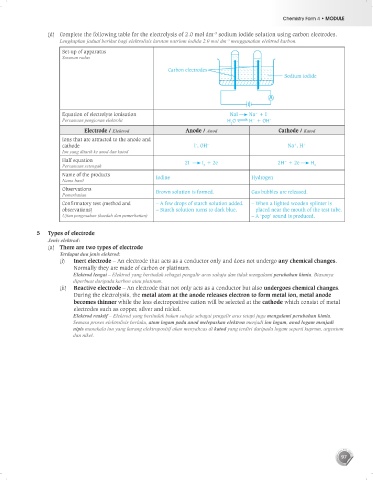
                    (d)  Complete the following table for the electrolysis of 2.0 mol dm  sodium iodide solution using carbon electrodes.
                                                                            –3
                        Lengkapkan jadual berikut bagi elektrolisis larutan natrium iodida 2.0 mol dm  menggunakan elektrod karbon.
                                                                                –3
                         Set-up of apparatus
                         Susunan radas

                                                             Carbon electrodes
                                                                                                    Sodium iodide


                         Equation of electrolyte ionisation                       NaI    Na  + I –
                                                                                          +
                         Persamaan pengionan elektrolit                          H O     H  + OH –
                                                                                         +
                                                                                  2
                                Electrode / Elektrod               Anode / Anod                   Cathode / Katod
                         Ions that are attracted to the anode and
                                                                      –
                         cathode                                     I , OH –                        Na , H +
                                                                                                        +
                         Ion yang ditarik ke anod dan katod
                         Half equation                            2I     I  + 2e                  2H  + 2e    H
                                                                    –
                                                                                                    +
                         Persamaan setengah                              2                                    2
                         Name of the products            Iodine                          Hydrogen
                         Nama hasil
                         Observations                    Brown solution is formed.       Gas bubbles are released.
                         Pemerhatian
                         Confirmatory test (method and   – A few drops of starch solution added.  – When a lighted wooden splinter is
                         observations)                   – Starch solution turns to dark blue.    placed near the mouth of the test tube.
                         Ujian pengesahan (kaedah dan pemerhatian)                       – A ‘pop’ sound is produced.

                5   Types of electrode
                    Jenis elektrod:
                    (a)  There are two types of electrode
                        Terdapat dua jenis elektrod:
                        (i)   Inert electrode – An electrode that acts as a conductor only and does not undergo any chemical changes.
                             Normally they are made of carbon or platinum.
                            Elektrod lengai – Elektrod yang bertindak sebagai pengalir arus sahaja dan tidak mengalami perubahan kimia. Biasanya
                            diperbuat daripada karbon atau platinum.
                        (ii)   Reactive electrode – An electrode that not only acts as a conductor but also undergoes chemical changes.
                             During the electrolysis, the metal atom at the anode releases electron to form metal ion, metal anode
                             becomes thinner while the less electropositive cation will be selected at the cathode which consist of metal
                             electrodes such as copper, silver and nickel.
                            Elektrod reaktif – Elektrod yang bertindak bukan sahaja sebagai pengalir arus tetapi juga mengalami perubahan kimia.
                            Semasa proses elektrolisis berlaku, atom logam pada anod melepaskan elektron menjadi ion logam, anod logam menjadi
                            nipis manakala ion yang kurang elektropositif akan menyahcas di katod yang terdiri daripada logam seperti kuprum, argentum
                            dan nikel.


                                                                                                                        97
                                                                                                                         Nilam Publication Sdn. Bhd.


        05-Chem F4 (3P).indd   97                                                                                  12/9/2011   5:56:29 PM

