


Page 47 - Human Environment Interface (3)
P. 47
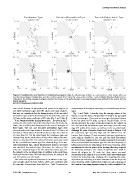
Learning Intermittent Strategy

Figure 8. Distributions of off-points in failed and successful trials. An off-point was defined as a state point at a time instant when an
inactive interval began. Configuration and data used for panels A to F were the same as those in Figs. 3 and 4. Q-Ratio (Quadrant-Ratio) used to
characterize the timing strategy of subjects counted the number of off-points located in the gray triangular areas defined in the second and the
fourth quadrants.
doi:10.1371/journal.pone.0062956.g008

index as SD. Because of well-localized off-points in the subjects of   characteristics of all subjects according to the classification of three
one-sided intermittent type, their SD-values were quite small. In      types.
this way, we considered that the timing-strategy of the one-sided
intermittent type could be characterized by the quite large value of      Fig. 7 and Table 3 describe how the average values of the
Q-Ratio and the quite small value of SD-value (Fig. 7 and Table 3).    indices, except DC-Ratio, changed from F5 trials to the successful
                                                                       trials in each subject. There were no clear type-dependent features
  3.4.1 Summary of the timing strategies. Bar plots in Fig. 7          in the bar plots for F5 trials, except in Inactive-Ratio. As we
summarize values of the five indices (Inactive-Ratio, DC-Ratio, Q-     already observed, the values of Inactive-Ratio for the subjects of
Ratio, Dis, and SD) that characterized the control strategies of       one and two-sided intermittent types were large from the early
three types. The one and two-sided intermittent types were             stage (F5 trials) of the session as well as in the successful trials.
characterized by the large values of Inactive-Ratio, DC-Ratio and      Although the value of Inactive-Ratio for F5 trials in Subject 11 of
Q-Ratio, in which values of all of these three indices were close to   the continuous type was also large and the differences in the
or more than 0.5. On the other hand, the continuous type was           Inactive-Ratio between F5 and successful trials were significant in
characterized by the small values of these three indices that were     some subjects classified in the one and two-sided intermittent
close to or less than 0.25. The values of SD-index were quite small    types, this feature suggested that the subjects adopted the strategies
for the one-sided intermittent type, but relatively large in the two-  of one and two-sided intermittent type did not react frequently to
sided intermittent type, which discriminated between one-sided         falling motions from the initial phase of the motor learning, which
and two-sided intermittent types. Moreover, the values of Dis-         was inherited in the late phase of the learning after they acquired
index were relatively large in the two-sided intermittent type. For    the balancing strategies. The values of Q-Ratio were small in
the subjects in the continuous type, in addition to the small three    almost all subjects for F5 trials, but those values increased
indices of Inactive-Ratio, DC-Ratio and Q-Ratio, the values of Dis     remarkably as the subjects of one and two-sided intermittent types
and SD indices were also small.                                        learned the balancing task, implying that acquiring this state-
                                                                       dependent optimal timing of muscle inactivation was the key to the
   We confirmed significant differences or similarities in the type-   motor learning, which enabled those subjects to take advantage of
wise average values of those indices, which were consistent with       the transient converging dynamics along the stable manifold of the
the type-wise characteristics described here. Table 3 summarizes

PLOS ONE | www.plosone.org                                             14 May 2013 | Volume 8 | Issue 5 | e62956

