


Page 42 - Human Environment Interface (3)
P. 42
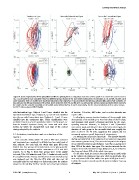
Learning Intermittent Strategy

Figure 4. Sway trajectories of the pendulum in the h-v phase plane. Configuration and data used for panels A to F were the same as those in
Fig. 3. Each trajectory was segmented into four different groups based on the associated combinations of activations in TA and MG muscles. Back
curve segments: Both TA and MG were inactivated (Inactive). Blue segments: TA was inactivated but MG was activated (MG-active). Red segments: TA
was activated but MG was inactivated (TA-active). Green segments: Both TA and MG were co-activated (Co-active). Dashed and dotted lines represent
the stable and the unstable manifolds of the saddle point defined by Eqs. 4 and 5, respectively, for the virtual pendulum with no active torque.
doi:10.1371/journal.pone.0062956.g004

sided intermittent type. Subjects 1 and 9 were classified into the         of inactive, TA-active, MG-active, and co-active intervals was
two-sided intermittent type. Subjects 2, 3, 5 and 8 were classified        equal to 60 s.
into the one-sided intermittent type. Subjects 4, 7 and 11 were
classified into the continuous type. Those classifications were               In all subjects, average inactive durations of the successful trials
performed based on several quantitative indices. In this sequel, we        decreased by a few seconds up to 10 s from those of the F5 trials,
describe detailed dynamics during the motor-task with those                and durations with muscle activations increased by the corre-
indices, by which we characterized each type of the control                sponding amounts. However, in Subjects 1 and 9 (two-sided
strategy adopted by the subjects.                                          intermittent type), and Subject 5 (one-sided intermittent type), the
                                                                           duration of each group in the successful trials was roughly the
3.2 Activation, inactivation and co-activation of the                      same as that in the F5 trials, suggesting that subjects did not
muscles                                                                    necessarily optimize overall frequency of interventions.

   Time intervals during which TA and/or MG were activated                   3.2.1 Duration of inactive intervals. The inactive intervals
and inactivated were analyzed for all failed and successful trials of      during successful trials in the subjects of one-sided and two-sided
nine subjects. For each trial, the whole time span (60 s) was              intermittent types were long. They were the longest for the subjects
divided into four groups of intervals based on the group-specific          of two-sided intermittent type (Subjects 1 and 9), occupying more
combinations of activation and/or inactivation of TA and MG                than 50% of the whole time span. The inactive intervals for the
muscles. As in Fig. 4, those four groups were 1) the inactive              subjects of one-sided intermittent type (Subjects 2, 3, 5 and 8) were
intervals, 2) the MG-active intervals, 3) the TA-active intervals, and 4)  also long and about 40% of the whole time span.
the co-active intervals. Average total duration of each interval group
was analyzed over the first five (F5) trials and also over all                On the other hand, the inactive intervals during successful trials
successful trials for each subject to characterize how the subjects        in the subjects of continuous type were short. In particular, they
adapted to the task (Fig. 5). Note that the sum of average durations       were only about 10% of the whole time span in Subjects 4 and 7.
                                                                           Indeed, the inactive interval was the shortest in Subject 4 among
                                                                           all subjects.

PLOS ONE | www.plosone.org                                                 9 May 2013 | Volume 8 | Issue 5 | e62956

