


Page 125 - Applied Statistics with R
P. 125
125


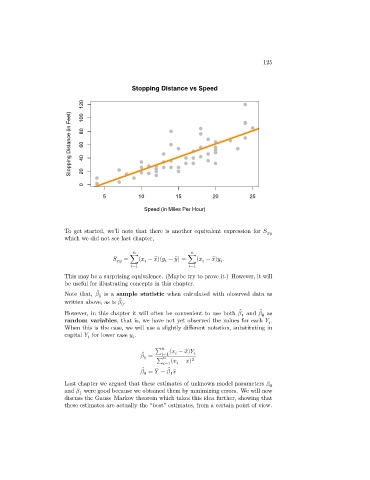
                                             Stopping Distance vs Speed

                             120  100
                        Stopping Distance (in Feet)  80  60  40


                             0  20
                                   5           10          15          20           25

                                                 Speed (in Miles Per Hour)


                      To get started, we’ll note that there is another equivalent expression for
                      which we did not see last chapter,


                                               = ∑(   − ̄  )(   − ̄  ) = ∑(   − ̄  )   .


                                              =1                 =1
                      This may be a surprising equivalence. (Maybe try to prove it.) However, it will
                      be useful for illustrating concepts in this chapter.
                                  ̂
                      Note that,    is a sample statistic when calculated with observed data as
                                  1
                                         ̂
                      written above, as is    .
                                         0
                                                                                        ̂
                                                                                 ̂
                      However, in this chapter it will often be convenient to use both    and    as
                                                                                        0
                                                                                 1
                      random variables, that is, we have not yet observed the values for each    .

                      When this is the case, we will use a slightly different notation, substituting in
                      capital    for lower case    .


                                                    ∑    (   − ̄  )

                                                 ̂
                                                  =     =1
                                                 1

                                                     ∑   (   − ̄  ) 2
                                                         =1
                                                          ̂
                                                 ̂
                                                     ̄
                                                  =    −       ̄
                                                 0
                                                         1
                      Last chapter we argued that these estimates of unknown model parameters    0
                      and    were good because we obtained them by minimizing errors. We will now
                           1
                      discuss the Gauss–Markov theorem which takes this idea further, showing that
                      these estimates are actually the “best” estimates, from a certain point of view.

