


Page 126 - Applied Statistics with R
P. 126
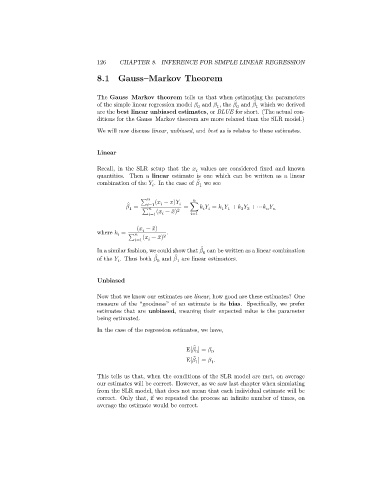
126     CHAPTER 8. INFERENCE FOR SIMPLE LINEAR REGRESSION

                                 8.1    Gauss–Markov Theorem


                                 The Gauss–Markov theorem tells us that when estimating the parameters
                                                                                      ̂
                                                                                ̂
                                 of the simple linear regression model    and    , the    and    which we derived
                                                                                      1
                                                                  0
                                                                         1
                                                                               0
                                 are the best linear unbiased estimates, or BLUE for short. (The actual con-
                                 ditions for the Gauss–Markov theorem are more relaxed than the SLR model.)
                                 We will now discuss linear, unbiased, and best as is relates to these estimates.
                                 Linear

                                 Recall, in the SLR setup that the    values are considered fixed and known

                                 quantities. Then a linear estimate is one which can be written as a linear
                                                                   ̂
                                 combination of the    . In the case of    we see
                                                                   1


                                                ∑   (   − ̄  )
                                            ̂
                                              =     =1          = ∑       =       +       + ⋯

                                            1
                                                                          1 1


                                                                                 2 2
                                                ∑    (   − ̄  ) 2
                                                    =1            =1
                                              (   − ̄  )

                                 where    =             .

                                           ∑    (   − ̄  ) 2
                                                =1
                                                                    ̂
                                 In a similar fashion, we could show that    can be written as a linear combination
                                                                    0
                                                            ̂
                                                     ̂
                                 of the    . Thus both    and    are linear estimators.

                                                     0
                                                            1
                                 Unbiased
                                 Now that we know our estimates are linear, how good are these estimates? One
                                 measure of the “goodness” of an estimate is its bias. Specifically, we prefer
                                 estimates that are unbiased, meaning their expected value is the parameter
                                 being estimated.
                                 In the case of the regression estimates, we have,
                                                                  ̂
                                                               E[   ] =    0
                                                                  0
                                                                  ̂
                                                               E[   ] =    .
                                                                  1
                                                                       1
                                 This tells us that, when the conditions of the SLR model are met, on average
                                 our estimates will be correct. However, as we saw last chapter when simulating
                                 from the SLR model, that does not mean that each individual estimate will be
                                 correct. Only that, if we repeated the process an infinite number of times, on
                                 average the estimate would be correct.

