


Page 130 - Applied Statistics with R
P. 130
130     CHAPTER 8. INFERENCE FOR SIMPLE LINEAR REGRESSION


                                                              ̂
                                                                ∼   (3, 0.04).
                                                              0
                                 That is,


                                                                ̂
                                                             E[   ] = 6
                                                                1
                                                                ̂
                                                           Var[   ] = 0.1176238
                                                                1
                                 and
                                                                  ̂
                                                               E[   ] = 3
                                                                  0
                                                                  ̂
                                                             Var[   ] = 0.04.
                                                                  0
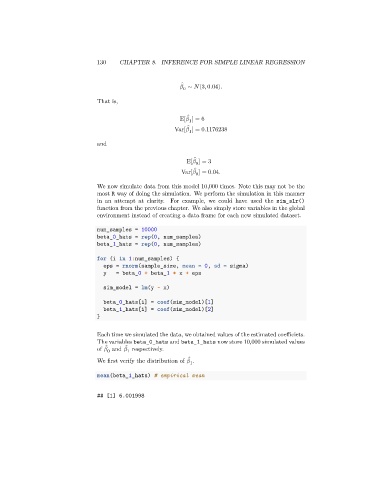
                                 We now simulate data from this model 10,000 times. Note this may not be the
                                 most R way of doing the simulation. We perform the simulation in this manner
                                 in an attempt at clarity. For example, we could have used the sim_slr()
                                 function from the previous chapter. We also simply store variables in the global
                                 environment instead of creating a data frame for each new simulated dataset.

                                 num_samples = 10000
                                 beta_0_hats = rep(0, num_samples)
                                 beta_1_hats = rep(0, num_samples)

                                 for (i in 1:num_samples) {
                                   eps = rnorm(sample_size, mean = 0, sd = sigma)
                                   y   = beta_0 + beta_1 * x + eps

                                   sim_model = lm(y ~ x)

                                   beta_0_hats[i] = coef(sim_model)[1]
                                   beta_1_hats[i] = coef(sim_model)[2]
                                 }

                                 Each time we simulated the data, we obtained values of the estimated coefficiets.
                                 The variables beta_0_hats and beta_1_hats now store 10,000 simulated values
                                           ̂
                                     ̂
                                 of    and    respectively.
                                           1
                                     0
                                                                ̂
                                 We first verify the distribution of    .
                                                                1
                                 mean(beta_1_hats) # empirical mean
                                 ## [1] 6.001998

