


Page 129 - Applied Statistics with R
P. 129
8.2. SAMPLING DISTRIBUTIONS                                       129


                         •    = 6
                            1
                             2
                         •    = 4
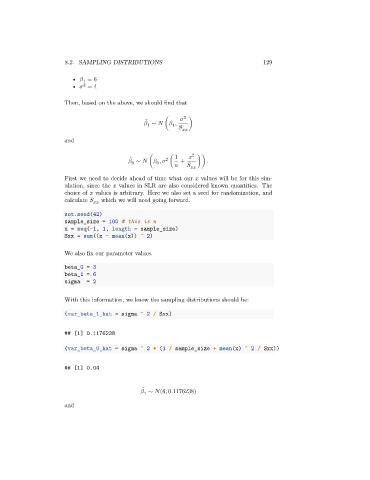
                      Then, based on the above, we should find that

                                                              2
                                                  ̂
                                                    ∼    (   ,              )
                                                  1
                                                          1
                      and

                                                                 2
                                                                 ̄
                                             ̂
                                                        2
                                              ∼    (   ,    ( 1  +           )) .
                                                     0
                                             0

                      First we need to decide ahead of time what our    values will be for this sim-
                      ulation, since the    values in SLR are also considered known quantities. The
                      choice of    values is arbitrary. Here we also set a seed for randomization, and
                      calculate          which we will need going forward.
                      set.seed(42)
                      sample_size = 100 # this is n
                      x = seq(-1, 1, length = sample_size)
                      Sxx = sum((x - mean(x)) ^ 2)


                      We also fix our parameter values.
                      beta_0 = 3
                      beta_1 = 6
                      sigma   = 2

                      With this information, we know the sampling distributions should be:

                      (var_beta_1_hat = sigma ^ 2 / Sxx)


                      ## [1] 0.1176238

                      (var_beta_0_hat = sigma ^ 2 * (1 / sample_size + mean(x) ^ 2 / Sxx))


                      ## [1] 0.04


                                                 ̂
                                                   ∼   (6, 0.1176238)
                                                 1
                      and

