


Page 173 - Applied Statistics with R
P. 173
9.3. SIGNIFICANCE OF REGRESSION                                   173


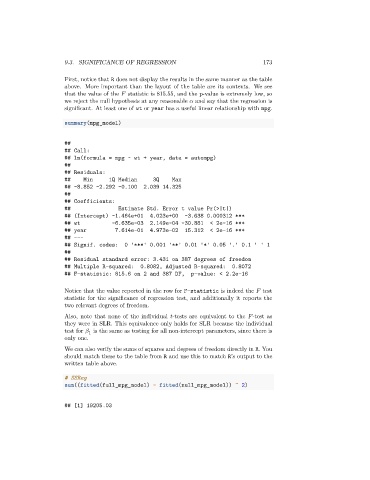
                      First, notice that R does not display the results in the same manner as the table
                      above. More important than the layout of the table are its contents. We see
                      that the value of the    statistic is 815.55, and the p-value is extremely low, so
                      we reject the null hypothesis at any reasonable    and say that the regression is
                      significant. At least one of wt or year has a useful linear relationship with mpg.

                      summary(mpg_model)


                      ##
                      ## Call:
                      ## lm(formula = mpg ~ wt + year, data = autompg)
                      ##
                      ## Residuals:
                      ##     Min     1Q Median      3Q    Max
                      ## -8.852 -2.292 -0.100    2.039 14.325
                      ##
                      ## Coefficients:
                      ##                Estimate Std. Error t value Pr(>|t|)
                      ## (Intercept) -1.464e+01    4.023e+00  -3.638 0.000312 ***
                      ## wt           -6.635e-03   2.149e-04 -30.881  < 2e-16 ***
                      ## year          7.614e-01   4.973e-02  15.312  < 2e-16 ***
                      ## ---
                      ## Signif. codes:   0 '***' 0.001 '**' 0.01 '*' 0.05 '.' 0.1 ' ' 1
                      ##
                      ## Residual standard error: 3.431 on 387 degrees of freedom
                      ## Multiple R-squared:   0.8082, Adjusted R-squared:    0.8072
                      ## F-statistic: 815.6 on 2 and 387 DF,    p-value: < 2.2e-16

                      Notice that the value reported in the row for F-statistic is indeed the    test
                      statistic for the significance of regression test, and additionally it reports the
                      two relevant degrees of freedom.

                      Also, note that none of the individual   -tests are equivalent to the   -test as
                      they were in SLR. This equivalence only holds for SLR because the individual
                      test for    is the same as testing for all non-intercept parameters, since there is
                              1
                      only one.
                      We can also verify the sums of squares and degrees of freedom directly in R. You
                      should match these to the table from R and use this to match R’s output to the
                      written table above.

                      # SSReg
                      sum((fitted(full_mpg_model) - fitted(null_mpg_model)) ^ 2)


                      ## [1] 19205.03

