


Page 176 - Applied Statistics with R
P. 176
176                   CHAPTER 9. MULTIPLE LINEAR REGRESSION


                                 Note that these are nested models, as the null model contains a subset of the
                                 predictors from the full model, and no additional predictors. Both models have
                                 an intercept    as well as a coefficient in front of each of the predictors. We
                                              0
                                 could then write the null hypothesis for comparing these two models as,

                                                        ∶    cyl  =    disp  =    hp  =    acc  = 0
                                                      0
                                 The alternative is simply that at least one of the    from the null is not 0.

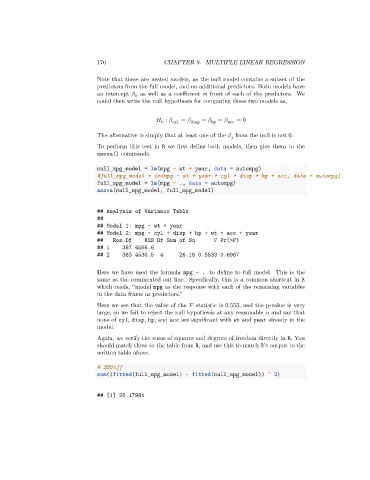
                                 To perform this test in R we first define both models, then give them to the
                                 anova() commands.

                                 null_mpg_model = lm(mpg ~ wt + year, data = autompg)
                                 #full_mpg_model = lm(mpg ~ wt + year + cyl + disp + hp + acc, data = autompg)
                                 full_mpg_model = lm(mpg ~ ., data = autompg)
                                 anova(null_mpg_model, full_mpg_model)


                                 ## Analysis of Variance Table
                                 ##
                                 ## Model 1: mpg ~ wt + year
                                 ## Model 2: mpg ~ cyl + disp + hp + wt + acc + year
                                 ##   Res.Df     RSS Df Sum of Sq       F Pr(>F)
                                 ## 1     387 4556.6
                                 ## 2     383 4530.5  4     26.18 0.5533 0.6967


                                 Here we have used the formula mpg ~ . to define to full model. This is the
                                 same as the commented out line. Specifically, this is a common shortcut in R
                                 which reads, “model mpg as the response with each of the remaining variables
                                 in the data frame as predictors.”
                                 Here we see that the value of the    statistic is 0.553, and the p-value is very
                                 large, so we fail to reject the null hypothesis at any reasonable    and say that
                                 none of cyl, disp, hp, and acc are significant with wt and year already in the
                                 model.
                                 Again, we verify the sums of squares and degrees of freedom directly in R. You
                                 should match these to the table from R, and use this to match R’s output to the
                                 written table above.

                                 # SSDiff
                                 sum((fitted(full_mpg_model) - fitted(null_mpg_model)) ^ 2)


                                 ## [1] 26.17981

