


Page 169 - Applied Statistics with R
P. 169
9.2. SAMPLING DISTRIBUTION                                        169


                                                          −14.6376419
                                       ⊤ ̂
                                ̂   (   ) =       = [1 3500  76] ⎡  −0.0066349  ⎤  = 20.0068411
                                                                     ⎥
                                                         ⎢
                                  0
                                       0
                                                         ⎣ 0.761402 ⎦
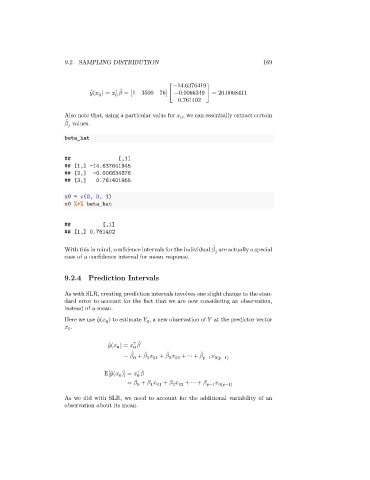
                      Also note that, using a particular value for    , we can essentially extract certain
                                                             0
                        ̂
                         values.

                      beta_hat
                      ##                [,1]
                      ## [1,] -14.637641945
                      ## [2,]   -0.006634876
                      ## [3,]    0.761401955

                      x0 = c(0, 0, 1)
                      x0 %*% beta_hat


                      ##           [,1]
                      ## [1,] 0.761402

                                                                        ̂
                      With this in mind, confidence intervals for the individual    are actually a special

                      case of a confidence interval for mean response.


                      9.2.4   Prediction Intervals

                      As with SLR, creating prediction intervals involves one slight change to the stan-
                      dard error to account for the fact that we are now considering an observation,
                      instead of a mean.
                      Here we use ̂(   ) to estimate    , a new observation of    at the predictor vector

                                                  0
                                    0
                         .
                        0
                                             ⊤ ̂
                                      ̂   (   ) =
                                        0
                                             0
                                                  ̂
                                                         ̂
                                                                    ̂
                                             ̂
                                          =    +        +        + ⋯ +      −1 0(  −1)

                                                         2 02
                                             0
                                                  1 01
                                              ⊤

                                   E[ ̂(   )] =
                                        0
                                              0
                                           =    +        +        + ⋯ +      −1 0(  −1)

                                                   1 01
                                                          2 02
                                              0
                      As we did with SLR, we need to account for the additional variability of an
                      observation about its mean.

