


Page 200 - Applied Statistics with R
P. 200
200 CHAPTER 11. CATEGORICAL PREDICTORS AND INTERACTIONS


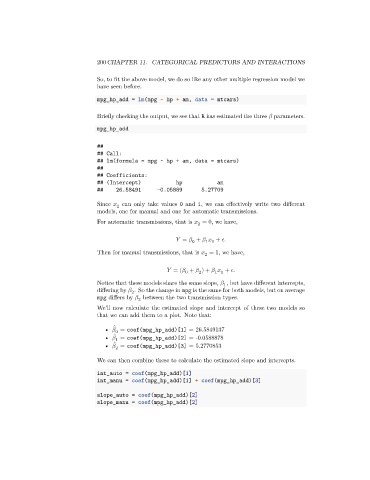
                                 So, to fit the above model, we do so like any other multiple regression model we
                                 have seen before.

                                 mpg_hp_add = lm(mpg ~ hp + am, data = mtcars)

                                 Briefly checking the output, we see that R has estimated the three    parameters.

                                 mpg_hp_add


                                 ##
                                 ## Call:
                                 ## lm(formula = mpg ~ hp + am, data = mtcars)
                                 ##
                                 ## Coefficients:
                                 ## (Intercept)            hp            am
                                 ##    26.58491      -0.05889       5.27709


                                 Since    can only take values 0 and 1, we can effectively write two different
                                        2
                                 models, one for manual and one for automatic transmissions.
                                 For automatic transmissions, that is    = 0, we have,
                                                                  2

                                                              =    +       +   .
                                                                     1 1
                                                                 0
                                 Then for manual transmissions, that is    = 1, we have,
                                                                     2
                                                           = (   +    ) +       +   .
                                                                        1 1
                                                                   2
                                                              0
                                 Notice that these models share the same slope,    , but have different intercepts,
                                                                           1
                                 differing by    . So the change in mpg is the same for both models, but on average
                                             2
                                 mpg differs by    between the two transmission types.
                                               2
                                 We’ll now calculate the estimated slope and intercept of these two models so
                                 that we can add them to a plot. Note that:
                                        ̂
                                    •    = coef(mpg_hp_add)[1] = 26.5849137
                                       0
                                        ̂
                                    •    = coef(mpg_hp_add)[2] = -0.0588878
                                       1
                                        ̂
                                    •    = coef(mpg_hp_add)[3] = 5.2770853
                                       2
                                 We can then combine these to calculate the estimated slope and intercepts.
                                 int_auto = coef(mpg_hp_add)[1]
                                 int_manu = coef(mpg_hp_add)[1] + coef(mpg_hp_add)[3]

                                 slope_auto = coef(mpg_hp_add)[2]
                                 slope_manu = coef(mpg_hp_add)[2]

