


Page 204 - Applied Statistics with R
P. 204
204 CHAPTER 11. CATEGORICAL PREDICTORS AND INTERACTIONS


                                 str(autompg)


                                 ## 'data.frame':     383 obs. of   9 variables:
                                 ##  $ mpg      : num  18 15 18 16 17 15 14 14 14 15 ...
                                 ##  $ cyl      : Factor w/ 3 levels "4","6","8": 3 3 3 3 3 3 3 3 3 3 ...
                                 ##  $ disp     : num  307 350 318 304 302 429 454 440 455 390 ...
                                 ##  $ hp       : num  130 165 150 150 140 198 220 215 225 190 ...
                                 ##  $ wt       : num  3504 3693 3436 3433 3449 ...
                                 ##  $ acc      : num  12 11.5 11 12 10.5 10 9 8.5 10 8.5 ...
                                 ##  $ year     : int  70 70 70 70 70 70 70 70 70 70 ...
                                 ##  $ origin   : int  1 1 1 1 1 1 1 1 1 1 ...
                                 ##  $ domestic: num   1 1 1 1 1 1 1 1 1 1 ...

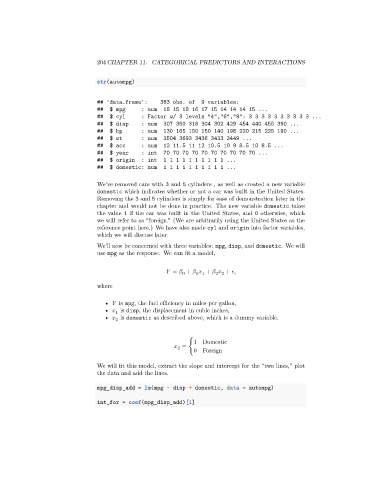
                                 We’ve removed cars with 3 and 5 cylinders , as well as created a new variable
                                 domestic which indicates whether or not a car was built in the United States.
                                 Removing the 3 and 5 cylinders is simply for ease of demonstration later in the
                                 chapter and would not be done in practice. The new variable domestic takes
                                 the value 1 if the car was built in the United States, and 0 otherwise, which
                                 we will refer to as “foreign.” (We are arbitrarily using the United States as the
                                 reference point here.) We have also made cyl and origin into factor variables,
                                 which we will discuss later.
                                 We’ll now be concerned with three variables: mpg, disp, and domestic. We will
                                 use mpg as the response. We can fit a model,

                                                           =    +       +       +   ,
                                                             0
                                                                  1 1
                                                                        2 2
                                 where

                                    •    is mpg, the fuel efficiency in miles per gallon,
                                    •    is disp, the displacement in cubic inches,
                                       1
                                    •    is domestic as described above, which is a dummy variable.
                                       2


                                                                 1  Domestic
                                                              = {
                                                            2
                                                                 0  Foreign
                                 We will fit this model, extract the slope and intercept for the “two lines,” plot
                                 the data and add the lines.

                                 mpg_disp_add = lm(mpg ~ disp + domestic, data = autompg)

                                 int_for = coef(mpg_disp_add)[1]

