


Page 201 - Applied Statistics with R
P. 201
11.1. DUMMY VARIABLES                                             201


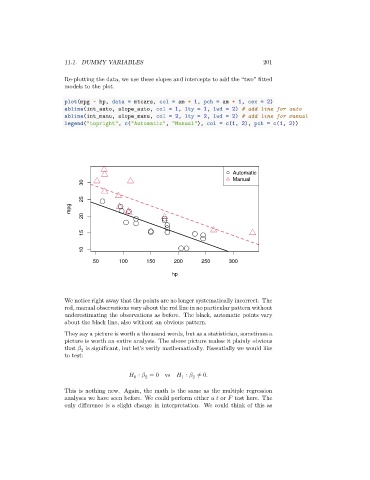
                      Re-plotting the data, we use these slopes and intercepts to add the “two” fitted
                      models to the plot.

                      plot(mpg ~ hp, data = mtcars, col = am + 1, pch = am + 1, cex = 2)
                      abline(int_auto, slope_auto, col = 1, lty = 1, lwd = 2) # add line for auto
                      abline(int_manu, slope_manu, col = 2, lty = 2, lwd = 2) # add line for manual
                      legend("topright", c("Automatic", "Manual"), col = c(1, 2), pch = c(1, 2))


                                                                              Automatic
                                                                              Manual
                             30

                             25
                        mpg
                             20

                             15


                             10
                                50      100      150       200      250      300

                                                          hp


                      We notice right away that the points are no longer systematically incorrect. The
                      red, manual observations vary about the red line in no particular pattern without
                      underestimating the observations as before. The black, automatic points vary
                      about the black line, also without an obvious pattern.
                      They say a picture is worth a thousand words, but as a statistician, sometimes a
                      picture is worth an entire analysis. The above picture makes it plainly obvious
                      that    is significant, but let’s verify mathematically. Essentially we would like
                            2
                      to test:


                                               ∶    = 0  vs    ∶    ≠ 0.
                                                             1
                                                 2
                                                                 2
                                             0
                      This is nothing new. Again, the math is the same as the multiple regression
                      analyses we have seen before. We could perform either a    or    test here. The
                      only difference is a slight change in interpretation. We could think of this as

