


Page 222 - Applied Statistics with R
P. 222
222 CHAPTER 11. CATEGORICAL PREDICTORS AND INTERACTIONS


                                 ## 12 14 340   0  0  1
                                 ## 13 15 400   0  0  1
                                 ## 14 14 455   0  0  1
                                 ## 15 24 113   1  0  0
                                 ## 16 22 198   0  1  0
                                 ## 17 18 199   0  1  0
                                 ## 18 21 200   0  1  0
                                 ## 19 27   97  1  0  0
                                 ## 20 26   97  1  0  0


                                 Now,

                                    • y is mpg
                                    • x is disp, the displacement in cubic inches,
                                    • v1, v2, and v3 are dummy variables as defined above.


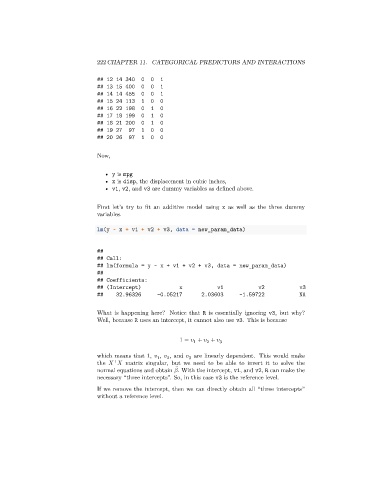
                                 First let’s try to fit an additive model using x as well as the three dummy
                                 variables.

                                 lm(y ~ x + v1 + v2 + v3, data = new_param_data)


                                 ##
                                 ## Call:
                                 ## lm(formula = y ~ x + v1 + v2 + v3, data = new_param_data)
                                 ##
                                 ## Coefficients:
                                 ## (Intercept)             x            v1           v2            v3
                                 ##    32.96326      -0.05217       2.03603     -1.59722            NA


                                 What is happening here? Notice that R is essentially ignoring v3, but why?
                                 Well, because R uses an intercept, it cannot also use v3. This is because


                                                            1 =    +    +    3
                                                                     2
                                                                 1
                                 which means that 1,    ,    , and    are linearly dependent. This would make
                                                     1
                                                        2
                                                               3
                                       ⊤
                                 the       matrix singular, but we need to be able to invert it to solve the
                                                            ̂
                                 normal equations and obtain   . With the intercept, v1, and v2, R can make the
                                 necessary “three intercepts”. So, in this case v3 is the reference level.
                                 If we remove the intercept, then we can directly obtain all “three intercepts”
                                 without a reference level.

