


Page 250 - Applied Statistics with R
P. 250
250                          CHAPTER 12. ANALYSIS OF VARIANCE


                                                        ∑    = 0     ∑    = 0.


                                 and


                                      (    ) 1    + (    ) 2    + (    ) 3    = 0(    ) + (    ) + (    ) + (    )   4  = 0
                                                                                      3
                                                                              2
                                                                      1
                                 for any    or   .
                                 Here,


                                    •    = 1, 2, …    where    is the number of levels of factor   .
                                    •    = 1, 2, …    where    is the number of levels of factor   .
                                    •    = 1, 2, …    where    is the number of replicates per group.

                                 Here, we can think of a group as a combination of a level from each of the
                                 factors. So for example, one group will receive level 2 of factor    and level 3
                                 of factor   . The number of replicates is the number of subjects in each group.
                                 Here    135  would be the measurement for the fifth member (replicate) of the
                                 group for level 1 of factor    and level 3 of factor   .
                                 We call this setup an    ×    factorial design with    replicates. (Our current
                                 notation only allows for equal replicates in each group. It isn’t difficult to
                                 allow for different replicates for different groups, but we’ll proceed using equal
                                 replicates per group, which if possible, is desirable.)

                                    •    measures the effect of level    of factor   . We call these the main

                                      effects of factor   .
                                    •    measures the effect of level    of factor   . We call these the main

                                      effects of factor   .
                                    • (    )       is a single parameter. We use      to note that this parameter
                                      measures the interaction between the two main effects.

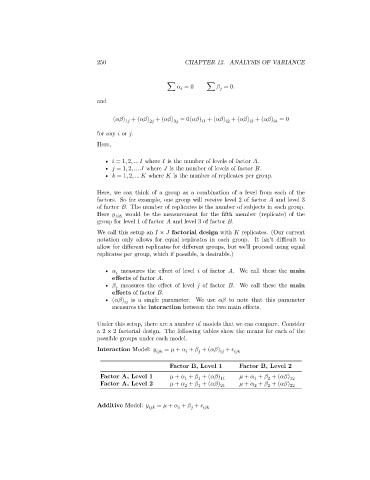
                                 Under this setup, there are a number of models that we can compare. Consider
                                 a 2 × 2 factorial design. The following tables show the means for each of the
                                 possible groups under each model.
                                 Interaction Model:            =    +    +    + (    ) +


                                                         Factor B, Level 1      Factor B, Level 2
                                  Factor A, Level 1         +    +    + (    ) 11     +    +    + (    ) 12
                                                                                          2
                                                                   1
                                                                                     1
                                                              1
                                  Factor A, Level 2         +    +    + (    ) 21     +    +    + (    ) 22
                                                                                          2
                                                              2
                                                                                     2
                                                                   1
                                 Additive Model:            =    +    +    +


