


Page 292 - Applied Statistics with R
P. 292
292                             CHAPTER 13. MODEL DIAGNOSTICS


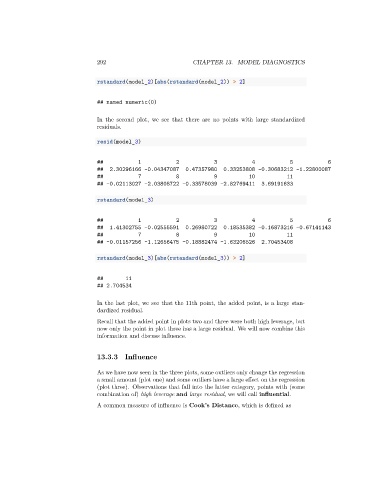
                                 rstandard(model_2)[abs(rstandard(model_2)) > 2]


                                 ## named numeric(0)


                                 In the second plot, we see that there are no points with large standardized
                                 residuals.

                                 resid(model_3)


                                 ##            1           2            3           4            5           6
                                 ##  2.30296166 -0.04347087   0.47357980   0.33253808 -0.30683212 -1.22800087
                                 ##            7           8            9          10           11
                                 ## -0.02113027 -2.03808722 -0.33578039 -2.82769411     3.69191633


                                 rstandard(model_3)


                                 ##            1           2            3           4            5           6
                                 ##  1.41302755 -0.02555591   0.26980722   0.18535382 -0.16873216 -0.67141143
                                 ##            7           8            9          10           11
                                 ## -0.01157256 -1.12656475 -0.18882474 -1.63206526     2.70453408


                                 rstandard(model_3)[abs(rstandard(model_3)) > 2]


                                 ##        11
                                 ## 2.704534


                                 In the last plot, we see that the 11th point, the added point, is a large stan-
                                 dardized residual.

                                 Recall that the added point in plots two and three were both high leverage, but
                                 now only the point in plot three has a large residual. We will now combine this
                                 information and discuss influence.


                                 13.3.3   Influence

                                 As we have now seen in the three plots, some outliers only change the regression
                                 a small amount (plot one) and some outliers have a large effect on the regression
                                 (plot three). Observations that fall into the latter category, points with (some
                                 combination of) high leverage and large residual, we will call influential.
                                 A common measure of influence is Cook’s Distance, which is defined as

