


Page 297 - Applied Statistics with R
P. 297
13.4. DATA ANALYSIS EXAMPLES                                      297


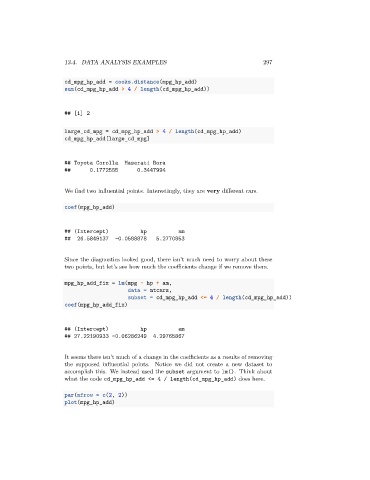
                      cd_mpg_hp_add = cooks.distance(mpg_hp_add)
                      sum(cd_mpg_hp_add > 4 / length(cd_mpg_hp_add))


                      ## [1] 2

                      large_cd_mpg = cd_mpg_hp_add > 4 / length(cd_mpg_hp_add)
                      cd_mpg_hp_add[large_cd_mpg]


                      ## Toyota Corolla   Maserati Bora
                      ##       0.1772555      0.3447994


                      We find two influential points. Interestingly, they are very different cars.

                      coef(mpg_hp_add)


                      ## (Intercept)           hp           am
                      ##   26.5849137  -0.0588878    5.2770853


                      Since the diagnostics looked good, there isn’t much need to worry about these
                      two points, but let’s see how much the coefficients change if we remove them.


                      mpg_hp_add_fix = lm(mpg ~ hp + am,
                                           data = mtcars,
                                           subset = cd_mpg_hp_add <= 4 / length(cd_mpg_hp_add))
                      coef(mpg_hp_add_fix)


                      ## (Intercept)           hp           am
                      ## 27.22190933 -0.06286249    4.29765867


                      It seems there isn’t much of a change in the coefficients as a results of removing
                      the supposed influential points. Notice we did not create a new dataset to
                      accomplish this. We instead used the subset argument to lm(). Think about
                      what the code cd_mpg_hp_add <= 4 / length(cd_mpg_hp_add) does here.

                      par(mfrow = c(2, 2))
                      plot(mpg_hp_add)

