


Page 320 - Applied Statistics with R
P. 320
320                              CHAPTER 14. TRANSFORMATIONS


                                 ##  $ acc      : num  12 11.5 11 12 10.5 10 9 8.5 10 8.5 ...
                                 ##  $ year     : int  70 70 70 70 70 70 70 70 70 70 ...
                                 ##  $ origin   : int  1 1 1 1 1 1 1 1 1 1 ...
                                 ##  $ domestic: num   1 1 1 1 1 1 1 1 1 1 ...


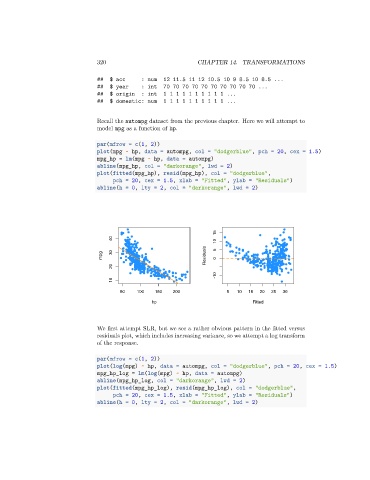
                                 Recall the autompg dataset from the previous chapter. Here we will attempt to
                                 model mpg as a function of hp.

                                 par(mfrow = c(1, 2))
                                 plot(mpg ~ hp, data = autompg, col = "dodgerblue", pch = 20, cex = 1.5)
                                 mpg_hp = lm(mpg ~ hp, data = autompg)
                                 abline(mpg_hp, col = "darkorange", lwd = 2)
                                 plot(fitted(mpg_hp), resid(mpg_hp), col = "dodgerblue",
                                      pch = 20, cex = 1.5, xlab = "Fitted", ylab = "Residuals")
                                 abline(h = 0, lty = 2, col = "darkorange", lwd = 2)


                                                                        15
                                      40                                10

                                   mpg  30                           Residuals  5  0
                                      20
                                                                        -10
                                      10

                                         50   100   150   200               5  10  15  20  25  30
                                                   hp                                Fitted


                                 We first attempt SLR, but we see a rather obvious pattern in the fitted versus
                                 residuals plot, which includes increasing variance, so we attempt a log transform
                                 of the response.

                                 par(mfrow = c(1, 2))
                                 plot(log(mpg) ~ hp, data = autompg, col = "dodgerblue", pch = 20, cex = 1.5)
                                 mpg_hp_log = lm(log(mpg) ~ hp, data = autompg)
                                 abline(mpg_hp_log, col = "darkorange", lwd = 2)
                                 plot(fitted(mpg_hp_log), resid(mpg_hp_log), col = "dodgerblue",
                                      pch = 20, cex = 1.5, xlab = "Fitted", ylab = "Residuals")
                                 abline(h = 0, lty = 2, col = "darkorange", lwd = 2)

