


Page 325 - Applied Statistics with R
P. 325
14.2. PREDICTOR TRANSFORMATION                                    325


                      ##          [,1]     [,2]       [,3]
                      ## [1,]    21.00   120.70    1107.95
                      ## [2,]   120.70  1107.95   12385.86
                      ## [3,] 1107.95 12385.86 151369.12


                      solve(t(X) %*% X) %*% t(X) %*% marketing$sales


                      ##              [,1]
                      ## [1,]   6.76161045
                      ## [2,]   2.46230964
                      ## [3,] -0.08745394


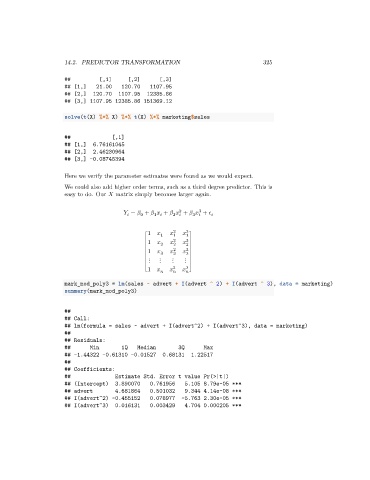
                      Here we verify the parameter estimates were found as we would expect.
                      We could also add higher order terms, such as a third degree predictor. This is
                      easy to do. Our    matrix simply becomes larger again.


                                                            2
                                                                   3
                                             =    +       +       +       +
                                                          2
                                                                 3

                                                0
                                                    1
                                                  1     1     2 1     3 1
                                                 ⎡        2    3 ⎤
                                                 ⎢ 1     2     2     2⎥
                                                 ⎢ 1         2     3 ⎥
                                                 ⎢    3   3    3 ⎥
                                                 ⎢ ⋮  ⋮   ⋮   ⋮ ⎥
                                                              3
                                                 ⎣1           2        ⎦

                      mark_mod_poly3 = lm(sales ~ advert + I(advert ^ 2) + I(advert ^ 3), data = marketing)
                      summary(mark_mod_poly3)

                      ##
                      ## Call:
                      ## lm(formula = sales ~ advert + I(advert^2) + I(advert^3), data = marketing)
                      ##
                      ## Residuals:
                      ##       Min       1Q   Median        3Q      Max
                      ## -1.44322 -0.61310 -0.01527    0.68131  1.22517
                      ##
                      ## Coefficients:
                      ##               Estimate Std. Error t value Pr(>|t|)
                      ## (Intercept)   3.890070    0.761956   5.105 8.79e-05 ***
                      ## advert        4.681864    0.501032   9.344 4.14e-08 ***
                      ## I(advert^2) -0.455152     0.078977  -5.763 2.30e-05 ***
                      ## I(advert^3)   0.016131    0.003429   4.704 0.000205 ***

