


Page 323 - Applied Statistics with R
P. 323
14.2. PREDICTOR TRANSFORMATION                                    323


                                      2
                      where    ∼   (0,    ) for    = 1, 2, ⋯ 21.

                      The response    is now a linear function of “two” variables which now allows
                         to be a non-linear function of the original single predictor   . We consider
                      this a transformation, although we have actually in some sense added another
                      predictor.

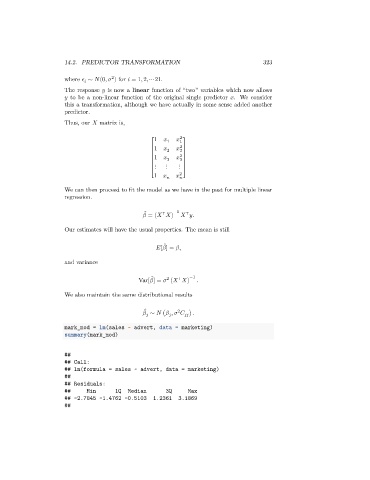
                      Thus, our    matrix is,

                                                    1     1     2 1
                                                   ⎡        2 ⎤
                                                   ⎢ 1     2     2⎥
                                                   ⎢ 1         2 ⎥
                                                   ⎢    3   3 ⎥
                                                   ⎢ ⋮  ⋮   ⋮ ⎥
                                                            2
                                                   ⎣1            ⎦

                      We can then proceed to fit the model as we have in the past for multiple linear
                      regression.

                                                  ̂
                                                       ⊤
                                                               ⊤
                                                   = (     ) −1       .
                      Our estimates will have the usual properties. The mean is still

                                                        ̂
                                                       [  ] =   ,

                      and variance

                                                    ̂
                                                            ⊤
                                                        2
                                               Var[  ] =    (     ) −1  .
                      We also maintain the same distributional results

                                                  ̂
                                                            2
                                                   ∼    (   ,       ) .


                      mark_mod = lm(sales ~ advert, data = marketing)
                      summary(mark_mod)
                      ##
                      ## Call:
                      ## lm(formula = sales ~ advert, data = marketing)
                      ##
                      ## Residuals:
                      ##      Min      1Q  Median       3Q     Max
                      ## -2.7845 -1.4762 -0.5103    1.2361  3.1869
                      ##

