


Page 367 - Applied Statistics with R
P. 367
15.1. EXACT COLLINEARITY                                          367


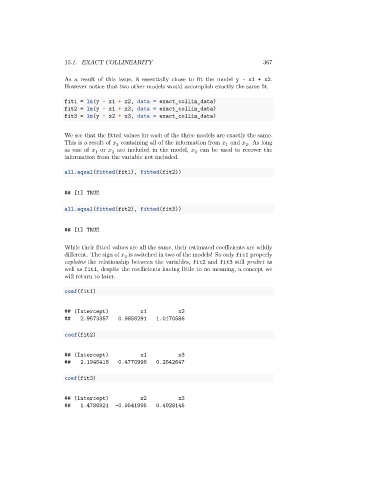
                      As a result of this issue, R essentially chose to fit the model y ~ x1 + x2.
                      However notice that two other models would accomplish exactly the same fit.

                      fit1 = lm(y ~ x1 + x2, data = exact_collin_data)
                      fit2 = lm(y ~ x1 + x3, data = exact_collin_data)
                      fit3 = lm(y ~ x2 + x3, data = exact_collin_data)


                      We see that the fitted values for each of the three models are exactly the same.
                      This is a result of    containing all of the information from    and    . As long
                                       3
                                                                            1
                                                                                  2
                      as one of    or    are included in the model,    can be used to recover the
                                                                 3
                                1
                                      2
                      information from the variable not included.
                      all.equal(fitted(fit1), fitted(fit2))
                      ## [1] TRUE

                      all.equal(fitted(fit2), fitted(fit3))


                      ## [1] TRUE

                      While their fitted values are all the same, their estimated coefficients are wildly
                      different. The sign of    is switched in two of the models! So only fit1 properly
                                          2
                      explains the relationship between the variables, fit2 and fit3 still predict as
                      well as fit1, despite the coefficients having little to no meaning, a concept we
                      will return to later.


                      coef(fit1)


                      ## (Intercept)           x1           x2
                      ##    2.9573357   0.9856291    1.0170586

                      coef(fit2)


                      ## (Intercept)           x1           x3
                      ##    2.1945418   0.4770998    0.2542647

                      coef(fit3)


                      ## (Intercept)           x2           x3
                      ##    1.4788921  -0.9541995    0.4928145

