


Page 379 - Applied Statistics with R
P. 379
15.3. SIMULATION                                                  379


                      par(mfrow = c(1, 2))
                      hist(beta_hat_bad[, 1],
                            col = "darkorange",
                            border = "dodgerblue",
                            main = expression("Histogram of " *hat(beta)[1]* " with Collinearity"),
                            xlab = expression(hat(beta)[1]),
                            breaks = 20)
                      hist(beta_hat_good[, 1],
                            col = "darkorange",
                            border = "dodgerblue",
                            main = expression("Histogram of " *hat(beta)[1]* " without Collinearity"),
                            xlab = expression(hat(beta)[1]),
                            breaks = 20)


                                       ^                                 ^
                                 Histogram of β 1  with Collinearity  Histogram of β 1  without Collinearity
                          300
                          250                               300
                          200
                       Frequency  150                     Frequency  200


                          100
                                                            100
                          50
                          0                                 0
                              -2  0   2   4   6   8   10      1     2      3     4     5
                                        ^                                  ^
                                        β 1                                β 1

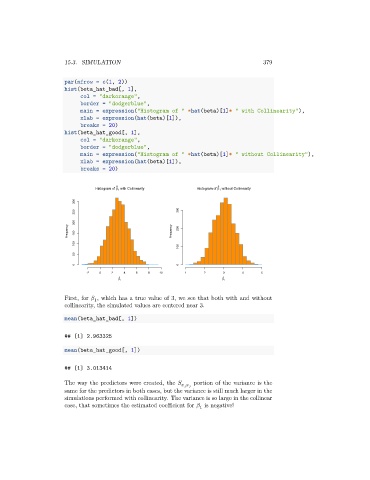
                      First, for    , which has a true value of 3, we see that both with and without
                                1
                      collinearity, the simulated values are centered near 3.
                      mean(beta_hat_bad[, 1])


                      ## [1] 2.963325

                      mean(beta_hat_good[, 1])

                      ## [1] 3.013414

                      The way the predictors were created, the     portion of the variance is the

                      same for the predictors in both cases, but the variance is still much larger in the
                      simulations performed with collinearity. The variance is so large in the collinear
                      case, that sometimes the estimated coefficient for    is negative!
                                                                   1

