


Page 378 - Applied Statistics with R
P. 378
378                                   CHAPTER 15. COLLINEARITY


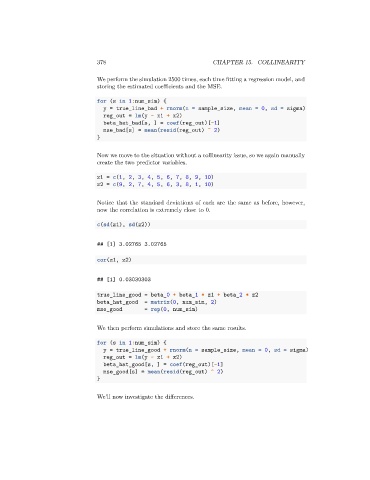
                                 We perform the simulation 2500 times, each time fitting a regression model, and
                                 storing the estimated coefficients and the MSE.

                                 for (s in 1:num_sim) {
                                   y = true_line_bad + rnorm(n = sample_size, mean = 0, sd = sigma)
                                   reg_out = lm(y ~ x1 + x2)
                                   beta_hat_bad[s, ] = coef(reg_out)[-1]
                                   mse_bad[s] = mean(resid(reg_out) ^ 2)
                                 }

                                 Now we move to the situation without a collinearity issue, so we again manually
                                 create the two predictor variables.

                                 z1 = c(1, 2, 3, 4, 5, 6, 7, 8, 9, 10)
                                 z2 = c(9, 2, 7, 4, 5, 6, 3, 8, 1, 10)


                                 Notice that the standard deviations of each are the same as before, however,
                                 now the correlation is extremely close to 0.

                                 c(sd(z1), sd(z2))


                                 ## [1] 3.02765 3.02765

                                 cor(z1, z2)


                                 ## [1] 0.03030303

                                 true_line_good = beta_0 + beta_1 * z1 + beta_2 * z2
                                 beta_hat_good   = matrix(0, num_sim, 2)
                                 mse_good        = rep(0, num_sim)


                                 We then perform simulations and store the same results.

                                 for (s in 1:num_sim) {
                                   y = true_line_good + rnorm(n = sample_size, mean = 0, sd = sigma)
                                   reg_out = lm(y ~ z1 + z2)
                                   beta_hat_good[s, ] = coef(reg_out)[-1]
                                   mse_good[s] = mean(resid(reg_out) ^ 2)
                                 }

                                 We’ll now investigate the differences.

