


Page 140 - First Aid for the USMLE Step 1 2020, Thirtieth edition [MedicalBooksVN.com]_Neat
P. 140
96 SECTIon II Immunology ` Immunology—lymphoId StructureS Immunology ` Immunology—lymphoId StructureS
` Immunology—lymphoId StructureS
Immune system 1° organs:
organs Bone marrow—immune cell production, B cell maturation
Thymus—T cell maturation
2° organs:
Spleen, lymph nodes, tonsils, Peyer patches
Allow immune cells to interact with antigen
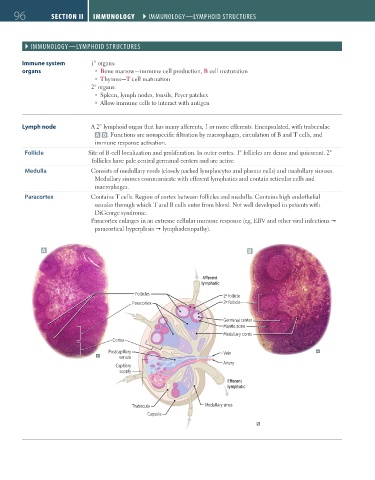
Lymph node A 2° lymphoid organ that has many afferents, 1 or more efferents. Encapsulated, with trabeculae
A B . Functions are nonspecific filtration by macrophages, circulation of B and T cells, and
immune response activation.
Follicle Site of B-cell localization and proliferation. In outer cortex. 1° follicles are dense and quiescent. 2°
follicles have pale central germinal centers and are active.
Medulla Consists of medullary cords (closely packed lymphocytes and plasma cells) and medullary sinuses.
Medullary sinuses communicate with efferent lymphatics and contain reticular cells and
macrophages.
Paracortex Contains T cells. Region of cortex between follicles and medulla. Contains high endothelial
venules through which T and B cells enter from blood. Not well developed in patients with
DiGeorge syndrome.
Paracortex enlarges in an extreme cellular immune response (eg, EBV and other viral infections
paracortical hyperplasia lymphadenopathy).
A B
A erent
lymphatic
Follicles 1º follicle
Paracortex 2º follicle
Germinal center
Mantle zone
Medullary cords
Cortex
Postcapillary Vein
venule
Artery
Capillary
supply
E erent
lymphatic
Trabecula Medullary sinus
Capsule
FAS1_2019_02-Immunology.indd 96 11/7/19 3:24 PM

