


Page 155 - First Aid for the USMLE Step 1 2020, Thirtieth edition [MedicalBooksVN.com]_Neat
P. 155
Immunology  ` Immunology—Immune reSponSeS       Immunology  ` Immunology—Immune reSponSeS             SECTIon II       111


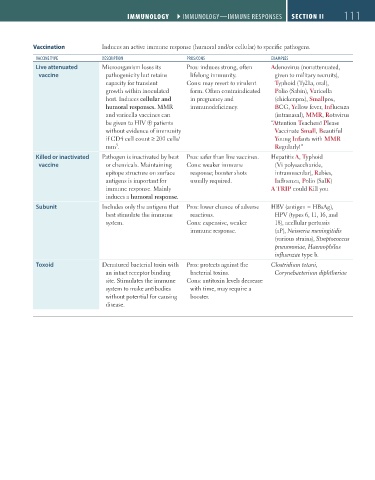
                  Vaccination            Induces an active immune response (humoral and/or cellular) to specific pathogens.
                   VaccIne type          deScrIptIon                 proS/conS                  eXampleS
                   Live attenuated       Microorganism loses its    Pros: induces strong, often   Adenovirus (nonattenuated,
                    vaccine               pathogenicity but retains   lifelong immunity.         given to military recruits),
                                          capacity for transient    Cons: may revert to virulent   Typhoid (Ty21a, oral),
                                          growth within inoculated    form. Often contraindicated   Polio (Sabin), Varicella
                                          host. Induces cellular and   in pregnancy and          (chickenpox), Smallpox,
                                          humoral responses. MMR      immunodeficiency.          BCG, Yellow fever, Influenza
                                          and varicella vaccines can                             (intranasal), MMR, Rotavirus
                                          be given to HIV ⊕ patients                            “Attention Teachers! Please
                                          without evidence of immunity                           Vaccinate Small, Beautiful
                                          if CD4 cell count ≥ 200 cells/                         Young Infants with MMR
                                             3
                                          mm .                                                   Regularly!”
                   Killed or inactivated   Pathogen is inactivated by heat   Pros: safer than live vaccines.  Hepatitis A, Typhoid
                    vaccine               or chemicals. Maintaining   Cons: weaker immune        (Vi polysaccharide,
                                          epitope structure on surface   response; booster shots   intramuscular), Rabies,
                                          antigens is important for   usually required.          Influenza, Polio (SalK)
                                          immune response. Mainly                               A TRIP could Kill you
                                          induces a humoral response.

                   Subunit               Includes only the antigens that   Pros: lower chance of adverse   HBV (antigen = HBsAg),
                                          best stimulate the immune   reactions.                 HPV (types 6, 11, 16, and
                                          system.                   Cons: expensive, weaker      18), acellular pertussis
                                                                      immune response.           (aP), Neisseria meningitidis
                                                                                                 (various strains), Streptococcus
                                                                                                 pneumoniae, Haemophilus
                                                                                                 influenzae type b.
                   Toxoid                Denatured bacterial toxin with   Pros: protects against the   Clostridium tetani,
                                          an intact receptor binding   bacterial toxins.         Corynebacterium diphtheriae
                                          site. Stimulates the immune   Cons: antitoxin levels decrease
                                          system to make antibodies   with time, may require a
                                          without potential for causing   booster.
                                          disease.


          FAS1_2019_02-Immunology.indd   111                                                                            11/7/19   3:24 PM

