


Page 300 - First Aid for the USMLE Step 1 2020, Thirtieth edition [MedicalBooksVN.com]_Neat
P. 300
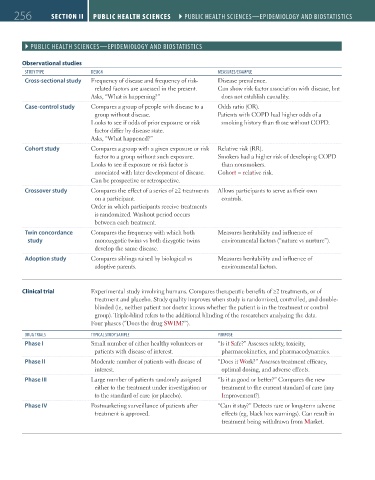
256         SectiOn ii    Public HealtH ScienceS  ` PUBLIC HEALTH SCIENCES—EPIdEmIoLogy ANd BIoSTATISTICS                    Public HealtH ScienceS  ` PUBLIC HEALTH SCIENCES—EPIdEmIoLogy ANd BIoSTATISTICS


                `  PUBLIC HEALTH SCIENCES—EPIdEmIoLogy ANd BIoSTATISTICS

               Observational studies
                STUdy TyPE           dESIgN                                    mEASURES/EXAmPLE
                Cross-sectional study  Frequency of disease and frequency of risk-  Disease prevalence.
                                       related factors are assessed in the present.  Can show risk factor association with disease, but
                                     Asks, “What is happening?”                 does not establish causality.
                Case-control study   Compares a group of people with disease to a   Odds ratio (OR).
                                      group without disease.                   Patients with COPD had higher odds of a
                                     Looks to see if odds of prior exposure or risk   smoking history than those without COPD.
                                      factor differ by disease state.
                                     Asks, “What happened?”
                Cohort study         Compares a group with a given exposure or risk   Relative risk (RR).
                                       factor to a group without such exposure.  Smokers had a higher risk of developing COPD
                                     Looks to see if exposure or risk factor is   than nonsmokers.
                                       associated with later development of disease.  Cohort = relative risk.
                                     Can be prospective or retrospective.
                Crossover study      Compares the effect of a series of ≥2 treatments   Allows participants to serve as their own
                                      on a participant.                         controls.
                                     Order in which participants receive treatments
                                      is randomized. Washout period occurs
                                      between each treatment.
                Twin concordance     Compares the frequency with which both    Measures heritability and influence of
                 study                monozygotic twins vs both dizygotic twins   environmental factors (“nature vs nurture”).
                                      develop the same disease.
                Adoption study       Compares siblings raised by biological vs   Measures heritability and influence of
                                      adoptive parents.                         environmental factors.


               Clinical trial        Experimental study involving humans. Compares therapeutic benefits of ≥2 treatments, or of
                                       treatment and placebo. Study quality improves when study is randomized, controlled, and double-
                                       blinded (ie, neither patient nor doctor knows whether the patient is in the treatment or control
                                       group). Triple-blind refers to the additional blinding of the researchers analyzing the data.
                                     Four phases (“Does the drug SWIM?”).

                dRUg TRIALS          TyPICAL STUdy SAmPLE                      PURPoSE
                Phase I              Small number of either healthy volunteers or   “Is it Safe?” Assesses safety, toxicity,
                                       patients with disease of interest.       pharmacokinetics, and pharmacodynamics.
                Phase II             Moderate number of patients with disease of   “Does it Work?” Assesses treatment efficacy,
                                       interest.                                optimal dosing, and adverse effects.
                Phase III            Large number of patients randomly assigned   “Is it as good or better?” Compares the new
                                       either to the treatment under investigation or   treatment to the current standard of care (any
                                       to the standard of care (or placebo).    Improvement?).
                Phase IV             Postmarketing surveillance of patients after   “Can it stay?” Detects rare or long-term adverse
                                       treatment is approved.                   effects (eg, black box warnings). Can result in
                                                                                treatment being withdrawn from Market.


          FAS1_2019_06-PubHealth.indd   256                                                                             11/7/19   4:16 PM

