


Page 304 - First Aid for the USMLE Step 1 2020, Thirtieth edition [MedicalBooksVN.com]_Neat
P. 304
260         SectiOn ii    Public HealtH ScienceS  ` PUBLIC HEALTH SCIENCES—EPIdEmIoLogy ANd BIoSTATISTICS                    Public HealtH ScienceS  ` PUBLIC HEALTH SCIENCES—EPIdEmIoLogy ANd BIoSTATISTICS


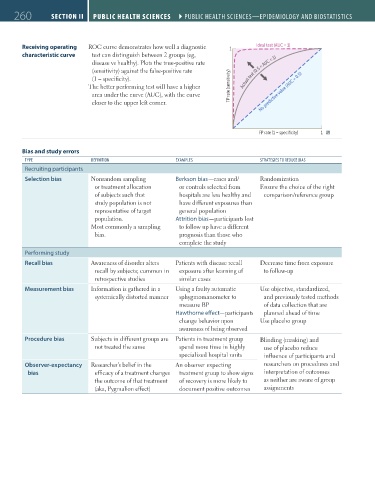
               Receiving operating   ROC curve demonstrates how well a diagnostic   1      Ideal test (AUC = 1)
               characteristic curve   test can distinguish between 2 groups (eg,
                                      disease vs healthy). Plots the true-positive rate
                                      (sensitivity) against the false-positive rate
                                      (1 – specificity).                                                 Actual test (0.5 < AUC < 1)
                                    The better performing test will have a higher   TP rate (sensitivity)
                                      area under the curve (AUC), with the curve             No predictive value (AUC = 0.5)
                                      closer to the upper left corner.


                                                                                            FP rate (1 – specificity)  1

               Bias and study errors
                TyPE                 dEFINITIoN                  EXAmPLES                    STRATEgIES To REdUCE BIAS
                Recruiting participants
                Selection bias       Nonrandom sampling          Berkson bias—cases and/     Randomization
                                       or treatment allocation    or controls selected from   Ensure the choice of the right
                                       of subjects such that      hospitals are less healthy and   comparison/reference group
                                       study population is not    have different exposures than
                                       representative of target   general population
                                       population.               Attrition bias—participants lost
                                     Most commonly a sampling     to follow up have a different
                                       bias.                      prognosis than those who
                                                                  complete the study
                Performing study
                Recall bias          Awareness of disorder alters   Patients with disease recall   Decrease time from exposure
                                       recall by subjects; common in   exposure after learning of   to follow-up
                                       retrospective studies      similar cases
                Measurement bias     Information is gathered in a   Using a faulty automatic   Use objective, standardized,
                                       systemically distorted manner  sphygmomanometer to     and previously tested methods
                                                                  measure BP                  of data collection that are
                                                                 Hawthorne effect—participants   planned ahead of time
                                                                  change behavior upon       Use placebo group
                                                                  awareness of being observed
                Procedure bias       Subjects in different groups are  Patients in treatment group   Blinding (masking) and
                                       not treated the same       spend more time in highly   use of placebo reduce
                                                                  specialized hospital units  influence of participants and
                Observer-expectancy   Researcher’s belief in the   An observer expecting      researchers on procedures and
                 bias                  efficacy of a treatment changes   treatment group to show signs   interpretation of outcomes
                                       the outcome of that treatment   of recovery is more likely to   as neither are aware of group
                                       (aka, Pygmalion effect)    document positive outcomes  assignments


          FAS1_2019_06-PubHealth.indd   260                                                                             11/7/19   4:16 PM

