


Page 382 - First Aid for the USMLE Step 1 2020, Thirtieth edition [MedicalBooksVN.com]_Neat
P. 382
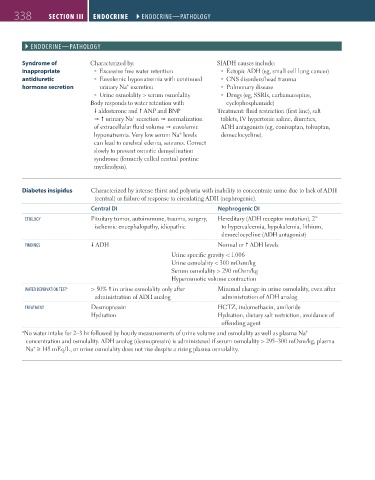
338 SEcTion iii EndocrinE ` endocrine—PAthology EndocrinE ` endocrine—PAthology
` endocrine—PAthology
Syndrome of Characterized by: SIADH causes include:
inappropriate Excessive free water retention Ectopic ADH (eg, small cell lung cancer)
antidiuretic Euvolemic hyponatremia with continued CNS disorders/head trauma
+
hormone secretion urinary Na excretion Pulmonary disease
Urine osmolality > serum osmolality Drugs (eg, SSRIs, carbamazepine,
Body responds to water retention with cyclophosphamide)
aldosterone and ANP and BNP Treatment: fluid restriction (first line), salt
+
urinary Na secretion normalization tablets, IV hypertonic saline, diuretics,
of extracellular fluid volume euvolemic ADH antagonists (eg, conivaptan, tolvaptan,
hyponatremia. Very low serum Na levels demeclocycline).
+
can lead to cerebral edema, seizures. Correct
slowly to prevent osmotic demyelination
syndrome (formerly called central pontine
myelinolysis).
Diabetes insipidus Characterized by intense thirst and polyuria with inability to concentrate urine due to lack of ADH
(central) or failure of response to circulating ADH (nephrogenic).
Central DI Nephrogenic DI
etiology Pituitary tumor, autoimmune, trauma, surgery, Hereditary (ADH receptor mutation), 2°
ischemic encephalopathy, idiopathic to hypercalcemia, hypokalemia, lithium,
demeclocycline (ADH antagonist)
Findings ADH Normal or ADH levels
Urine specific gravity < 1.006
Urine osmolality < 300 mOsm/kg
Serum osmolality > 290 mOsm/kg
Hyperosmotic volume contraction
WAter dePriVAtion test a > 50% in urine osmolality only after Minimal change in urine osmolality, even after
administration of ADH analog administration of ADH analog
treAtment Desmopressin HCTZ, indomethacin, amiloride
Hydration Hydration, dietary salt restriction, avoidance of
offending agent
a No water intake for 2–3 hr followed by hourly measurements of urine volume and osmolality as well as plasma Na
+
concentration and osmolality. ADH analog (desmopressin) is administered if serum osmolality > 295–300 mOsm/kg, plasma
+
Na ≥ 145 mEq/L, or urine osmolality does not rise despite a rising plasma osmolality.
FAS1_2019_08-Endocrine.indd 338 11/7/19 4:30 PM

