


Page 386 - First Aid for the USMLE Step 1 2020, Thirtieth edition [MedicalBooksVN.com]_Neat
P. 386
342 SEcTion iii EndocrinE ` endocrine—PAthology EndocrinE ` endocrine—PAthology
Hyperthyroidism
Graves disease Most common cause of hyperthyroidism. Thyroid-stimulating immunoglobulin (IgG, can cause
transient neonatal hyperthyroidism; type II hypersensitivity) stimulates TSH receptors on thyroid
A
(hyperthyroidism, diffuse goiter), dermal fibroblasts (pretibial myxedema), and orbital fibroblasts
(Graves orbitopathy). Activation of T-cells lymphocytic infiltration of retroorbital space
cytokines (eg, TNF-α, IFN-γ) fibroblast secretion of hydrophilic GAGs osmotic
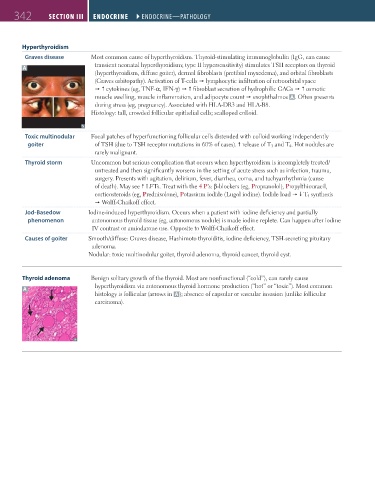
muscle swelling, muscle inflammation, and adipocyte count exophthalmos A . Often presents
during stress (eg, pregnancy). Associated with HLA-DR3 and HLA-B8.
Histology: tall, crowded follicular epithelial cells; scalloped colloid.
Toxic multinodular Focal patches of hyperfunctioning follicular cells distended with colloid working independently
goiter of TSH (due to TSH receptor mutations in 60% of cases). release of T 3 and T 4 . Hot nodules are
rarely malignant.
Thyroid storm Uncommon but serious complication that occurs when hyperthyroidism is incompletely treated/
untreated and then significantly worsens in the setting of acute stress such as infection, trauma,
surgery. Presents with agitation, delirium, fever, diarrhea, coma, and tachyarrhythmia (cause
of death). May see LFTs. Treat with the 4 P’s: β-blockers (eg, Propranolol), Propylthiouracil,
corticosteroids (eg, Prednisolone), Potassium iodide (Lugol iodine). Iodide load T 4 synthesis
Wolff-Chaikoff effect.
Jod-Basedow Iodine-induced hyperthyroidism. Occurs when a patient with iodine deficiency and partially
phenomenon autonomous thyroid tissue (eg, autonomous nodule) is made iodine replete. Can happen after iodine
IV contrast or amiodarone use. Opposite to Wolff-Chaikoff effect.
Causes of goiter Smooth/diffuse: Graves disease, Hashimoto thyroiditis, iodine deficiency, TSH-secreting pituitary
adenoma.
Nodular: toxic multinodular goiter, thyroid adenoma, thyroid cancer, thyroid cyst.
Thyroid adenoma Benign solitary growth of the thyroid. Most are nonfunctional (“cold”), can rarely cause
A hyperthyroidism via autonomous thyroid hormone production (“hot” or “toxic”). Most common
histology is follicular (arrows in A ); absence of capsular or vascular invasion (unlike follicular
carcinoma).
FAS1_2019_08-Endocrine.indd 342 11/7/19 4:30 PM

