


Page 387 - First Aid for the USMLE Step 1 2020, Thirtieth edition [MedicalBooksVN.com]_Neat
P. 387
EndocrinE ` endocrine—PAthology EndocrinE ` endocrine—PAthology SEcTion iii 343
Thyroid cancer Typically diagnosed with fine needle aspiration; treated with thyroidectomy. Complications of
surgery include hypocalcemia (due to removal of parathyroid glands), transection of recurrent
laryngeal nerve during ligation of inferior thyroid artery (leads to dysphagia and dysphonia
[hoarseness]), and injury to the external branch of the superior laryngeal nerve during ligation of
superior thyroid vascular pedicle (may lead to loss of tenor usually noticeable in professional voice
users).
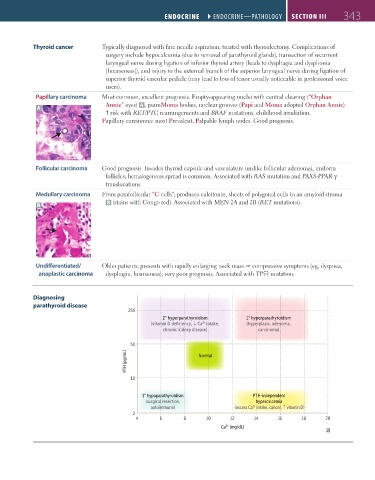
Papillary carcinoma Most common, excellent prognosis. Empty-appearing nuclei with central clearing (“Orphan
Annie” eyes) A , psamMoma bodies, nuclear grooves (Papi and Moma adopted Orphan Annie).
A
risk with RET/PTC rearrangements and BRAF mutations, childhood irradiation.
Papillary carcinoma: most Prevalent, Palpable lymph nodes. Good prognosis.
Follicular carcinoma Good prognosis. Invades thyroid capsule and vasculature (unlike follicular adenoma), uniform
follicles; hematogenous spread is common. Associated with RAS mutation and PAX8-PPAR-γ
translocations.
Medullary carcinoma From parafollicular “C cells”; produces calcitonin, sheets of polygonal cells in an amyloid stroma
B (stains with Congo red). Associated with MEN 2A and 2B (RET mutations).
B
Undifferentiated/ Older patients; presents with rapidly enlarging neck mass compressive symptoms (eg, dyspnea,
anaplastic carcinoma dysphagia, hoarseness); very poor prognosis. Associated with TP53 mutation.
Diagnosing
parathyroid disease
250
2° hyperparathyroidism 1° hyperparathyroidism
2+
(vitamin D deficiency, ↓ Ca intake, (hyperplasia, adenoma,
chronic kidney disease) carcinoma)
50
PTH (pg/mL) Normal
10
1° hypoparathyroidism PTH-independent
(surgical resection, hypercalcemia
2+
autoimmune) (excess Ca intake, cancer, ↑ vitamin D)
2
4 6 8 10 12 14 16 18 20
2+
Ca (mg/dL)
FAS1_2019_08-Endocrine.indd 343 11/7/19 4:30 PM

