


Page 394 - First Aid for the USMLE Step 1 2020, Thirtieth edition [MedicalBooksVN.com]_Neat
P. 394
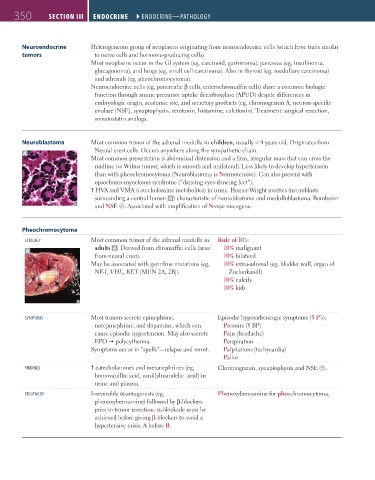
350 SEcTion iii EndocrinE ` endocrine—PAthology EndocrinE ` endocrine—PAthology
Neuroendocrine Heterogeneous group of neoplasms originating from neuroendocrine cells (which have traits similar
tumors to nerve cells and hormone-producing cells).
Most neoplasms occur in the GI system (eg, carcinoid, gastrinoma), pancreas (eg, insulinoma,
glucagonoma), and lungs (eg, small cell carcinoma). Also in thyroid (eg, medullary carcinoma)
and adrenals (eg, pheochromocytoma).
Neuroendocrine cells (eg, pancreatic β cells, enterochromaffin cells) share a common biologic
function through amine precursor uptake decarboxylase (APUD) despite differences in
embryologic origin, anatomic site, and secretory products (eg, chromogranin A, neuron-specific
enolase [NSE], synaptophysin, serotonin, histamine, calcitonin). Treatment: surgical resection,
somatostatin analogs.
Neuroblastoma Most common tumor of the adrenal medulla in children, usually < 4 years old. Originates from
Neural crest cells. Occurs anywhere along the sympathetic chain.
A
Most common presentation is abdominal distension and a firm, irregular mass that can cross the
midline (vs Wilms tumor, which is smooth and unilateral). Less likely to develop hypertension
than with pheochromocytoma (Neuroblastoma is Normotensive). Can also present with
opsoclonus-myoclonus syndrome (“dancing eyes-dancing feet”).
HVA and VMA (catecholamine metabolites) in urine. Homer-Wright rosettes (neuroblasts
surrounding a central lumen A ) characteristic of neuroblastoma and medulloblastoma. Bombesin
and NSE ⊕. Associated with amplification of N-myc oncogene.
Pheochromocytoma
etiology Most common tumor of the adrenal medulla in Rule of 10’s:
adults A . Derived from chromaffin cells (arise 10% malignant
A
from neural crest). 10% bilateral
May be associated with germline mutations (eg, 10% extra-adrenal (eg, bladder wall, organ of
NF-1, VHL, RET [MEN 2A, 2B]). Zuckerkandl)
10% calcify
10% kids
symPtoms Most tumors secrete epinephrine, Episodic hyperadrenergic symptoms (5 P’s):
norepinephrine, and dopamine, which can Pressure ( BP)
cause episodic hypertension. May also secrete Pain (headache)
EPO polycythemia. Perspiration
Symptoms occur in “spells”—relapse and remit. Palpitations (tachycardia)
Pallor
Findings catecholamines and metanephrines (eg, Chromogranin, synaptophysin and NSE ⊕.
homovanillic acid, vanillylmandelic acid) in
urine and plasma.
treAtment Irreversible α-antagonists (eg, Phenoxybenzamine for pheochromocytoma.
phenoxybenzamine) followed by β-blockers
prior to tumor resection. α-blockade must be
achieved before giving β-blockers to avoid a
hypertensive crisis. A before B.
FAS1_2019_08-Endocrine.indd 350 11/7/19 4:30 PM

