


Page 395 - First Aid for the USMLE Step 1 2020, Thirtieth edition [MedicalBooksVN.com]_Neat
P. 395
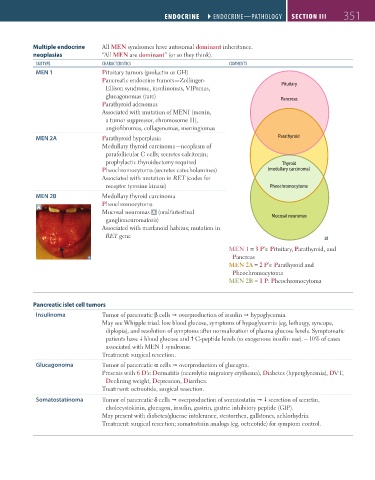
EndocrinE ` endocrine—PAthology EndocrinE ` endocrine—PAthology SEcTion iii 351
Multiple endocrine All MEN syndromes have autosomal dominant inheritance.
neoplasias “All MEN are dominant” (or so they think).
sUbtyPe chArActeristics comments
MEN 1 Pituitary tumors (prolactin or GH)
Pancreatic endocrine tumors—Zollinger-
Ellison syndrome, insulinomas, VIPomas, Pituitary
glucagonomas (rare) Pancreas
Parathyroid adenomas
Associated with mutation of MEN1 (menin,
a tumor suppressor, chromosome 11),
angiofibromas, collagenomas, meningiomas
MEN 2A Parathyroid hyperplasia Parathyroid
Medullary thyroid carcinoma—neoplasm of
parafollicular C cells; secretes calcitonin;
prophylactic thyroidectomy required Thyroid
Pheochromocytoma (secretes catecholamines) (medullary carcinoma)
Associated with mutation in RET (codes for
receptor tyrosine kinase) Pheochromocytoma
MEN 2B Medullary thyroid carcinoma
Pheochromocytoma
A
Mucosal neuromas A (oral/intestinal
ganglioneuromatosis) Mucosal neuromas
Associated with marfanoid habitus; mutation in
RET gene
MEN 1 = 3 P’s: Pituitary, Parathyroid, and
Pancreas
MEN 2A = 2 P’s: Parathyroid and
Pheochromocytoma
MEN 2B = 1 P: Pheochromocytoma
Pancreatic islet cell tumors
Insulinoma Tumor of pancreatic β cells overproduction of insulin hypoglycemia.
May see Whipple triad: low blood glucose, symptoms of hypoglycemia (eg, lethargy, syncope,
diplopia), and resolution of symptoms after normalization of plasma glucose levels. Symptomatic
patients have blood glucose and C-peptide levels (vs exogenous insulin use). ∼ 10% of cases
associated with MEN 1 syndrome.
Treatment: surgical resection.
Glucagonoma Tumor of pancreatic α cells overproduction of glucagon.
Presents with 6 D’s: Dermatitis (necrolytic migratory erythema), Diabetes (hyperglycemia), DVT,
Declining weight, Depression, Diarrhea.
Treatment: octreotide, surgical resection.
Somatostatinoma Tumor of pancreatic δ cells overproduction of somatostatin secretion of secretin,
cholecystokinin, glucagon, insulin, gastrin, gastric inhibitory peptide (GIP).
May present with diabetes/glucose intolerance, steatorrhea, gallstones, achlorhydria.
Treatment: surgical resection; somatostatin analogs (eg, octreotide) for symptom control.
FAS1_2019_08-Endocrine.indd 351 11/7/19 4:30 PM

