


Page 392 - First Aid for the USMLE Step 1 2020, Thirtieth edition [MedicalBooksVN.com]_Neat
P. 392
348 SEcTion iii EndocrinE ` endocrine—PAthology EndocrinE ` endocrine—PAthology
Cushing syndrome
etiology cortisol due to a variety of causes:
Exogenous corticosteroids ACTH bilateral adrenal atrophy. Most common cause.
Primary adrenal adenoma, hyperplasia, or carcinoma ACTH atrophy of uninvolved
adrenal gland.
ACTH-secreting pituitary adenoma (Cushing disease); paraneoplastic ACTH secretion (eg,
small cell lung cancer, bronchial carcinoids) bilateral adrenal hyperplasia. Cushing disease is
responsible for the majority of endogenous cases of Cushing syndrome.
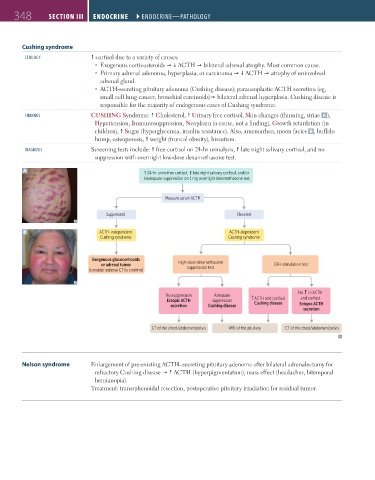
Findings CUSHING Syndrome: Cholesterol, Urinary free cortisol, Skin changes (thinning, striae A ),
Hypertension, Immunosuppression, Neoplasm (a cause, not a finding), Growth retardation (in
children), Sugar (hyperglycemia, insulin resistance). Also, amenorrhea, moon facies B , buffalo
hump, osteoporosis, weight (truncal obesity), hirsutism.
diAgnosis Screening tests include: free cortisol on 24-hr urinalysis, late night salivary cortisol, and no
suppression with overnight low-dose dexamethasone test.
A ↑ 24-hr urine free cortisol, ↑ late night salivary cortisol, and/or
inadequate suppression on 1 mg overnight dexamethasone test
Measure serum ACTH
Suppressed Elevated
B ACTH-independent ACTH-dependent
Cushing syndrome Cushing syndrome
Exogenous glucocorticoids
or adrenal tumor High-dose dexamethasone CRH stimulation test
suppression test
(consider adrenal CT to confirm)
↑
No in ACTH
No suppression Adequate and cortisol
Ectopic ACTH suppression ↑ ACTH and cortisol
secretion Cushing disease Cushing disease Ectopic ACTH
secretion
CT of the chest/abdomen/pelvis MRI of the pituitary CT of the chest/abdomen/pelvis
Nelson syndrome Enlargement of pre-existing ACTH–secreting pituitary adenoma after bilateral adrenalectomy for
refractory Cushing disease ACTH (hyperpigmentation), mass effect (headaches, bitemporal
hemianopia).
Treatment: transsphenoidal resection, postoperative pituitary irradiation for residual tumor.
FAS1_2019_08-Endocrine.indd 348 11/7/19 4:30 PM

