


Page 473 - First Aid for the USMLE Step 1 2020, Thirtieth edition [MedicalBooksVN.com]_Neat
P. 473
Hematology and oncology ` hematology and oncology—Pathology Hematology and oncology ` hematology and oncology—Pathology SectIon III 429
Blood transfusion therapy
comPonent doSage eFFect clInIcal USe
Packed RBCs Hb and O carrying capacity Acute blood loss, severe anemia
2
Platelets platelet count ( ∼ 5000/mm /unit) Stop significant bleeding (thrombocytopenia,
3
qualitative platelet defects)
Fresh frozen coagulation factor levels; FFP contains all Cirrhosis, immediate anticoagulation reversal
plasma/prothrombin coagulation factors and plasma proteins; PCC
complex concentrate generally contains factors II, VII, IX, and X, as
well as protein C and S
Cryoprecipitate Contains fibrinogen, factor VIII, factor XIII, Coagulation factor deficiencies involving
vWF, and fibronectin fibrinogen and factor VIII
Blood transfusion risks include infection transmission (low), transfusion reactions, iron overload (may lead to 2°
hemochromatosis), hypocalcemia (citrate is a Ca chelator), and hyperkalemia (RBCs may lyse in old blood units).
2+
Leukemia vs lymphoma
Leukemia Lymphoid or myeloid neoplasm with widespread involvement of bone marrow. Tumor cells are
usually found in peripheral blood.
Lymphoma Discrete tumor mass arising from lymph nodes. Presentations often blur definitions.
Hodgkin vs Hodgkin Non-Hodgkin
non‑Hodgkin Both may present with constitutional (“B”) signs/symptoms: low-grade fever, night sweats, weight
lymphoma loss.
Localized, single group of nodes with Multiple lymph nodes involved; extranodal
contiguous spread (stage is strongest predictor involvement common; noncontiguous spread.
of prognosis). Better prognosis. Worse prognosis.
Characterized by Reed-Sternberg cells. Majority involve B cells; a few are of T-cell
lineage.
Bimodal distribution: young adulthood and Can occur in children and adults.
> 55 years; more common in men except for
nodular sclerosing type.
Associated with EBV. May be associated with autoimmune diseases
and viral infections (eg, HIV, EBV, HTLV).
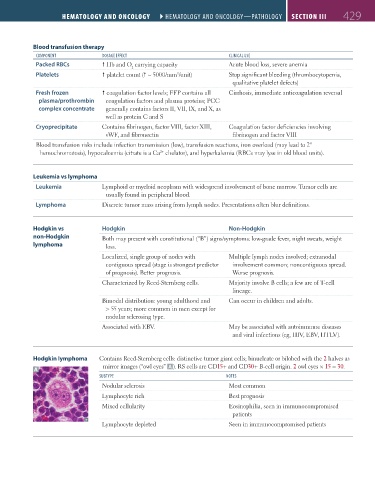
Hodgkin lymphoma Contains Reed-Sternberg cells: distinctive tumor giant cells; binucleate or bilobed with the 2 halves as
mirror images (“owl eyes” A ). RS cells are CD15+ and CD30+ B-cell origin. 2 owl eyes × 15 = 30.
A
SUBtyPe noteS
Nodular sclerosis Most common
Lymphocyte rich Best prognosis
Mixed cellularity Eosinophilia, seen in immunocompromised
patients
Lymphocyte depleted Seen in immunocompromised patients
FAS1_2019_10-HemaOncol.indd 429 11/7/19 5:05 PM

