


Page 475 - First Aid for the USMLE Step 1 2020, Thirtieth edition [MedicalBooksVN.com]_Neat
P. 475
Hematology and oncology ` hematology and oncology—Pathology Hematology and oncology ` hematology and oncology—Pathology SectIon III 431
Plasma cell dyscrasias Characterized by monoclonal immunoglobulin (Ig) overproduction due to plasma cell disorder.
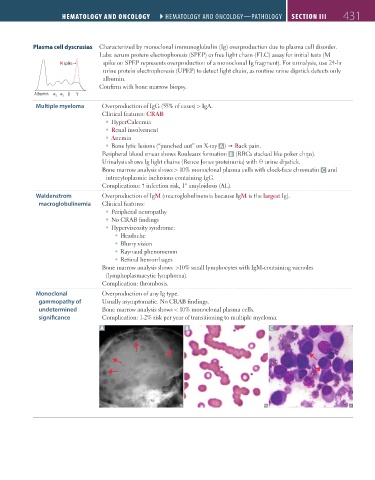
Labs: serum protein electrophoresis (SPEP) or free light chain (FLC) assay for initial tests (M
M spike spike on SPEP represents overproduction of a monoclonal Ig fragment). For urinalysis, use 24-hr
urine protein electrophoresis (UPEP) to detect light chain, as routine urine dipstick detects only
albumin.
Confirm with bone marrow biopsy.
Albumin α α β γ
Multiple myeloma Overproduction of IgG (55% of cases) > IgA.
Clinical features: CRAB
HyperCalcemia
Renal involvement
Anemia
Bone lytic lesions (“punched out” on X-ray A ) Back pain.
Peripheral blood smear shows Rouleaux formation B (RBCs stacked like poker chips).
Urinalysis shows Ig light chains (Bence Jones proteinuria) with ⊖ urine dipstick.
Bone marrow analysis shows > 10% monoclonal plasma cells with clock-face chromatin C and
intracytoplasmic inclusions containing IgG.
Complications: infection risk, 1° amyloidosis (AL).
Waldenstrom Overproduction of IgM (macroglobulinemia because IgM is the largest Ig).
macroglobulinemia Clinical features:
Peripheral neuropathy
No CRAB findings
Hyperviscosity syndrome:
Headache
Blurry vision
Raynaud phenomenon
Retinal hemorrhages
Bone marrow analysis shows >10% small lymphocytes with IgM-containing vacuoles
(lymphoplasmacytic lymphoma).
Complication: thrombosis.
Monoclonal Overproduction of any Ig type.
gammopathy of Usually asymptomatic. No CRAB findings.
undetermined Bone marrow analysis shows < 10% monoclonal plasma cells.
significance Complication: 1-2% risk per year of transitioning to multiple myeloma.
A B C
FAS1_2019_10-HemaOncol.indd 431 11/7/19 5:05 PM

