


Page 474 - First Aid for the USMLE Step 1 2020, Thirtieth edition [MedicalBooksVN.com]_Neat
P. 474
430        SectIon III    Hematology and oncology   ` hematology and oncology—Pathology                                                   Hematology and oncology   ` hematology and oncology—Pathology


               Non‑Hodgkin lymphoma
                tyPe                 occURS In            genetIcS             commentS
                Neoplasms of mature B cells
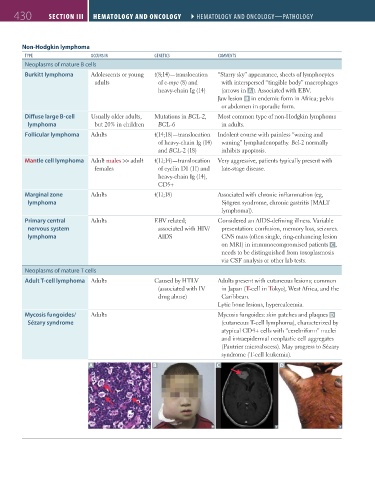
                Burkitt lymphoma     Adolescents or young   t(8;14)—translocation   “Starry sky” appearance, sheets of lymphocytes
                                       adults              of c-myc (8) and     with interspersed “tingible body” macrophages
                                                           heavy-chain Ig (14)  (arrows in  A ). Associated with EBV.
                                                                               Jaw lesion  B  in endemic form in Africa; pelvis
                                                                                or abdomen in sporadic form.
                Diffuse large B-cell   Usually older adults,   Mutations in BCL-2,   Most common type of non-Hodgkin lymphoma
                 lymphoma             but 20% in children  BCL-6                in adults.
                Follicular lymphoma  Adults               t(14;18)—translocation  Indolent course with painless “waxing and
                                                           of heavy-chain Ig (14)   waning” lymphadenopathy. Bcl-2 normally
                                                           and BCL-2 (18)       inhibits apoptosis.
                Mantle cell lymphoma  Adult males >> adult   t(11;14)—translocation   Very aggressive, patients typically present with
                                      females              of cyclin D1 (11) and   late-stage disease.
                                                           heavy-chain Ig (14),
                                                           CD5+
                Marginal zone        Adults               t(11;18)             Associated with chronic inflammation (eg,
                 lymphoma                                                       Sjögren syndrome, chronic gastritis [MALT
                                                                                lymphoma]).
                Primary central      Adults               EBV related;         Considered an AIDS-defining illness. Variable
                 nervous system                            associated with HIV/  presentation: confusion, memory loss, seizures.
                 lymphoma                                  AIDS                 CNS mass (often single, ring-enhancing lesion
                                                                                on MRI) in immunocompromised patients  C ,
                                                                                needs to be distinguished from toxoplasmosis
                                                                                via CSF analysis or other lab tests.
                Neoplasms of mature T cells
                Adult T-cell lymphoma Adults              Caused by HTLV       Adults present with cutaneous lesions; common
                                                           (associated with IV   in Japan (T-cell in Tokyo), West Africa, and the
                                                           drug abuse)          Caribbean.
                                                                               Lytic bone lesions, hypercalcemia.

                Mycosis fungoides/   Adults                                    Mycosis fungoides: skin patches and plaques  D
                 Sézary syndrome                                                (cutaneous T-cell lymphoma), characterized by
                                                                                atypical CD4+ cells with “cerebriform” nuclei
                                                                                and intraepidermal neoplastic cell aggregates
                                                                                (Pautrier microabscess). May progress to Sézary
                                                                                syndrome (T-cell leukemia).
                                     A                    B                   C                    D


          FAS1_2019_10-HemaOncol.indd   430                                                                             11/7/19   5:05 PM

