


Page 476 - First Aid for the USMLE Step 1 2020, Thirtieth edition [MedicalBooksVN.com]_Neat
P. 476
432 SectIon III Hematology and oncology ` hematology and oncology—Pathology Hematology and oncology ` hematology and oncology—Pathology
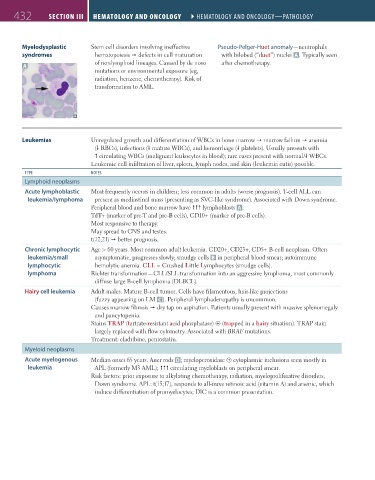
Myelodysplastic Stem cell disorders involving ineffective Pseudo-Pelger-Huet anomaly—neutrophils
syndromes hematopoiesis defects in cell maturation with bilobed (“duet”) nuclei A . Typically seen
of nonlymphoid lineages. Caused by de novo after chemotherapy.
A
mutations or environmental exposure (eg,
radiation, benzene, chemotherapy). Risk of
transformation to AML.
Leukemias Unregulated growth and differentiation of WBCs in bone marrow marrow failure anemia
( RBCs), infections ( mature WBCs), and hemorrhage ( platelets). Usually presents with
circulating WBCs (malignant leukocytes in blood); rare cases present with normal/ WBCs.
Leukemic cell infiltration of liver, spleen, lymph nodes, and skin (leukemia cutis) possible.
tyPe noteS
Lymphoid neoplasms
Acute lymphoblastic Most frequently occurs in children; less common in adults (worse prognosis). T-cell ALL can
leukemia/lymphoma present as mediastinal mass (presenting as SVC-like syndrome). Associated with Down syndrome.
Peripheral blood and bone marrow have lymphoblasts A .
TdT+ (marker of pre-T and pre-B cells), CD10+ (marker of pre-B cells).
Most responsive to therapy.
May spread to CNS and testes.
t(12;21) better prognosis.
Chronic lymphocytic Age > 60 years. Most common adult leukemia. CD20+, CD23+, CD5+ B-cell neoplasm. Often
leukemia/small asymptomatic, progresses slowly; smudge cells B in peripheral blood smear; autoimmune
lymphocytic hemolytic anemia. CLL = Crushed Little Lymphocytes (smudge cells).
lymphoma Richter transformation—CLL/SLL transformation into an aggressive lymphoma, most commonly
diffuse large B-cell lymphoma (DLBCL).
Hairy cell leukemia Adult males. Mature B-cell tumor. Cells have filamentous, hair-like projections
(fuzzy appearing on LM C ). Peripheral lymphadenopathy is uncommon.
Causes marrow fibrosis dry tap on aspiration. Patients usually present with massive splenomegaly
and pancytopenia.
Stains TRAP (tartrate-resistant acid phosphatase) ⊕ (trapped in a hairy situation). TRAP stain
largely replaced with flow cytometry. Associated with BRAF mutations.
Treatment: cladribine, pentostatin.
Myeloid neoplasms
Acute myelogenous Median onset 65 years. Auer rods D; myeloperoxidase ⊕ cytoplasmic inclusions seen mostly in
leukemia APL (formerly M3 AML); circulating myeloblasts on peripheral smear.
Risk factors: prior exposure to alkylating chemotherapy, radiation, myeloproliferative disorders,
Down syndrome. APL: t(15;17), responds to all-trans retinoic acid (vitamin A) and arsenic, which
induce differentiation of promyelocytes; DIC is a common presentation.
FAS1_2019_10-HemaOncol.indd 432 11/7/19 5:05 PM

