


Page 480 - First Aid for the USMLE Step 1 2020, Thirtieth edition [MedicalBooksVN.com]_Neat
P. 480
436 SectIon III Hematology and oncology ` hematology and oncology—PhaRmacology Hematology and oncology ` hematology and oncology—PhaRmacology
Heparin
mechanISm Activates antithrombin, which action of IIa (thrombin) and factor Xa. Short half-life.
clInIcal USe Immediate anticoagulation for pulmonary embolism (PE), acute coronary syndrome, MI, deep
venous thrombosis (DVT). Used during pregnancy (does not cross placenta). Follow PTT.
adVeRSe eFFectS Bleeding, thrombocytopenia (HIT), osteoporosis, drug-drug interactions. For rapid reversal
(antidote), use protamine sulfate (positively charged molecule that binds negatively charged
heparin).
noteS Low-molecular-weight heparins (eg, enoxaparin, dalteparin)—act predominantly on factor Xa.
Fondaparinux acts only on factor Xa. Have better bioavailability and 2–4× longer half life than
unfractionated heparin; can be administered subcutaneously and without laboratory monitoring.
LMWHs undergo renal clearance (vs hepatic clearance of unfractionated heparin) and are
contraindicated in renal insufficiency. Not easily reversible.
Heparin-induced thrombocytopenia (HIT) type 2—development of IgG antibodies against
heparin-bound platelet factor 4 (PF4). Antibody-heparin-PF4 complex activates platelets
thrombosis and thrombocytopenia. Highest risk with unfractionated heparin. HIT type 1
characterized by nonimmunologic milder drop in platelet count, usually asymptomatic.
Warfarin
mechanISm Inhibits epoxide reductase, which interferes The EX-PresidenT went to war(farin).
with γ-carboxylation of vitamin K–dependent
clotting factors II, VII, IX, X, and proteins C,
S. Metabolism affected by polymorphisms
in the gene for vitamin K epoxide reductase
complex (VKORC1). In laboratory assay, has
effect on EXtrinsic pathway and PT. Long
half-life.
clInIcal USe Chronic anticoagulation (eg, venous
thromboembolism prophylaxis, and prevention
of stroke in atrial fibrillation). Not used in
pregnant women (because warfarin, unlike
heparin, crosses placenta). Follow PT/INR.
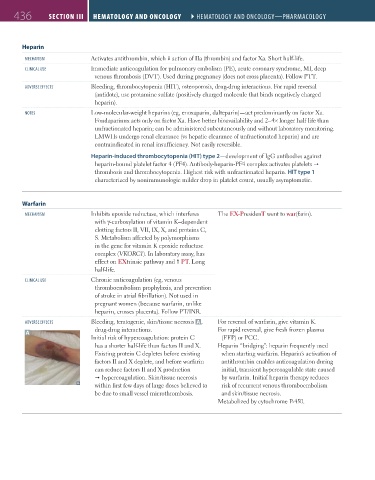
adVeRSe eFFectS Bleeding, teratogenic, skin/tissue necrosis A , For reversal of warfarin, give vitamin K.
A drug-drug interactions. For rapid reversal, give fresh frozen plasma
Initial risk of hypercoagulation: protein C (FFP) or PCC.
has a shorter half-life than factors II and X. Heparin “bridging”: heparin frequently used
Existing protein C depletes before existing when starting warfarin. Heparin’s activation of
factors II and X deplete, and before warfarin antithrombin enables anticoagulation during
can reduce factors II and X production initial, transient hypercoagulable state caused
hypercoagulation. Skin/tissue necrosis by warfarin. Initial heparin therapy reduces
within first few days of large doses believed to risk of recurrent venous thromboembolism
be due to small vessel microthrombosis. and skin/tissue necrosis.
Metabolized by cytochrome P-450.
FAS1_2019_10-HemaOncol.indd 436 11/7/19 5:05 PM

