


Page 196 - The City and Guilds Textbook: Plumbing Book 1 for the Level 3 Apprenticeship (9189), Level 2 Technical Certificate (8202) and Level 2 Diploma (6035)
P. 196
The City & Guilds Textbook: Plumbing Book 1


                                             Resistance      ohm                R or Ω      Unit of DC resistance
                                                                                            R = V ÷ I
                                             Conductance     siemen             G           Reciprocal of resistance
                                                                                            G = 1 ÷ R
                                             Capacitance     farad              C           Unit of capacitance
                                                                                            C = Q ÷ V
                                             Charge          coulomb            Q           Unit of electrical charge
                                                                                            Q = C × V
                                             Power           watts              W           Unit of power
                                                                                            P = V × I

                KEY TERMS                   The basic principles of electron flow

                Molecule: the smallest      Everything is made up of molecules, and these in turn are made up of atoms.
                particle of a specific
                element or compound         Atoms consist of even smaller particles. At the centre of every atom is a nucleus,
                that retains the chemical   which is made up of protons and neutrons. Protons have a positive (+) electrical
                properties of that element   charge whilst neutrons do not have an electrical charge – they are neutral.
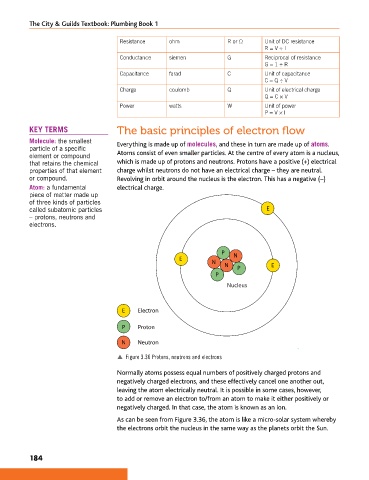
                or compound.                Revolving in orbit around the nucleus is the electron. This has a negative (−)
                Atom: a fundamental         electrical charge.
                piece of matter made up
                of three kinds of particles
                called subatomic particles                                                   E
                – protons, neutrons and
                electrons.


                                                                              P
                                                                E                 N
                                                                           N
                                                                               N              E
                                                                                   P
                                                                            P
                                                                                Nucleus


                                              E    Electron

                                              P    Proton

                                              N    Neutron
                                                                                                       .
                                            p  Figure 3.36 Protons, neutrons and electrons

                                            Normally atoms possess equal numbers of positively charged protons and
                                            negatively charged electrons, and these effectively cancel one another out,
                                            leaving the atom electrically neutral. It is possible in some cases, however,
                                            to add or remove an electron to/from an atom to make it either positively or
                                            negatively charged. In that case, the atom is known as an ion.
                                            As can be seen from Figure 3.36, the atom is like a micro-solar system whereby
                                            the electrons orbit the nucleus in the same way as the planets orbit the Sun.


                184


        9781510416482.indb   184                                                                                    29/03/19   8:55 PM

